Hi-Rel Plastics & Molding Corp. provides precision pad printing services for plastic components, molded parts, housings, bottles, containers, assemblies, and finished products for OEMs and product manufacturers throughout California and across the United States.
Pad printing is a versatile decorating and product-marking process capable of transferring detailed graphics, logos, lettering, symbols, instructions, and identification markings onto flat, curved, recessed, textured, and irregularly shaped surfaces.
As an ISO 9001, AS9100 and ISO 13485 certified manufacturer, Hi-Rel Plastics & Molding can integrate pad printing with plastic injection molding, medical clean room injection molding, blow molding, mold manufacturing, machining, assembly, ultrasonic welding, adhesive bonding, labeling, hot stamping, inspection, and custom packaging.
This integrated manufacturing approach allows customers to move from an unfinished molded component to a printed, assembled, inspected, and packaged product through a single manufacturing partner.
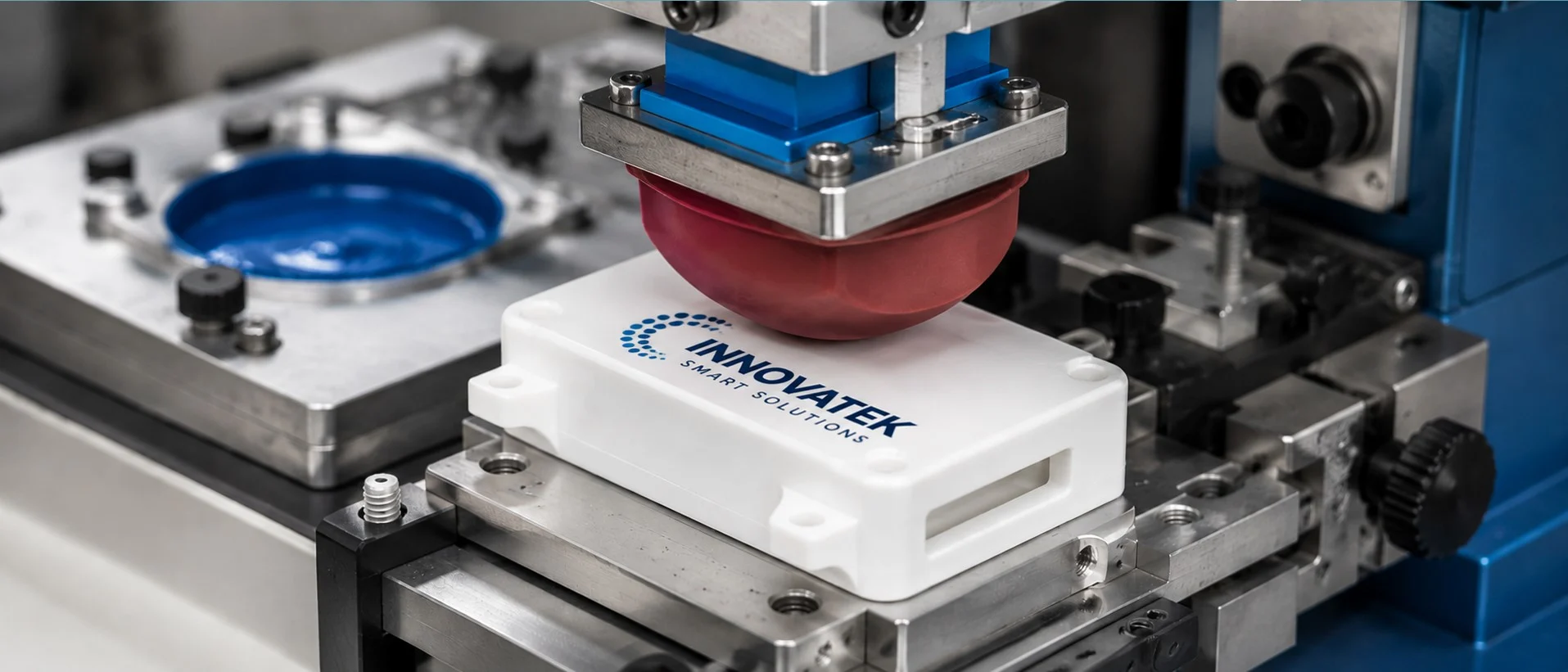
Pad printing uses a flexible silicone pad to transfer ink from an etched printing plate, commonly called a cliché, onto the surface of a manufactured component.
Because the silicone pad can conform to complex shapes, pad printing can apply detailed graphics where many conventional printing methods are difficult to use.
Potential applications include:
The appropriate process depends on the part material, surface geometry, print area, artwork, ink requirements, color requirements, production quantity, and end-use environment.
One of the primary advantages of pad printing is its ability to decorate three-dimensional components.
The flexible printing pad can conform to surfaces including:
This makes pad printing particularly useful for plastic products where the desired graphic cannot easily be applied using traditional flat-surface printing.
Potential components can include housings, knobs, buttons, switches, handles, medical device components, electronics enclosures, cosmetic components, automotive controls, bottle closures, instrument components, and other custom molded products.
A major advantage of working with Hi-Rel Plastics & Molding is the ability to combine plastic injection molding and pad printing through the same manufacturing partner.
Our plastic injection molding services support precision custom plastic components for medical, aerospace and defense, automotive, electronics, industrial, consumer, and other demanding industries.
After molding, qualifying components can move directly into secondary operations such as:
Integrating molding and printing helps customers reduce the need to ship parts to a separate decorating company.
Pad printing can apply company logos and branding directly to a molded plastic component.
Applications can include:
Directly printing the molded component can eliminate the need for a separate label in certain applications and can provide a clean, integrated product appearance.
Hi-Rel Plastics & Molding can coordinate artwork requirements with component geometry and production requirements before full-scale manufacturing begins.
Pad printing is not limited to decorative graphics.
The process can also be used for functional product markings such as:
These applications are common in medical equipment, electronics, automotive controls, industrial equipment, appliances, laboratory products, and consumer devices.
Hi-Rel Plastics & Molding can support single-color and multicolor pad printing for qualifying applications.
Single-color printing may be suitable for:
Multicolor printing can support more complex branding or decorative requirements when the part geometry, artwork, registration requirements, and production process are appropriate.
Color requirements should be defined during quotation so that artwork, print sequence, registration, ink selection, and inspection expectations can be evaluated.
Successful pad printing depends heavily on compatibility between the ink system and the surface being printed.
Different thermoplastic resins have different surface characteristics that can affect ink adhesion.
Potential plastic substrates may include:
Actual printability depends on the specific resin grade, additives, surface texture, mold release, colorant, environmental exposure, ink system, and finished-product requirements.
For this reason, material compatibility and print requirements should be evaluated for each application rather than assuming that all plastic grades behave the same.
The surface condition of a molded component can significantly affect print quality and ink adhesion.
Potential factors include:
Components should be sufficiently clean and suitable for the selected printing process before ink application.
For demanding applications, Hi-Rel Plastics & Molding can evaluate the substrate and printing requirements during process development.
Consistent graphic placement is important for both appearance and product functionality. Pad printing programs can involve customer-defined requirements for:
Fixtures may be used to maintain repeatable part positioning during production.
Print inspection requirements can be incorporated into customer-approved work instructions and quality requirements.
Pad printing and hot stamping are both useful plastic decorating processes, but they work differently.
Pad printing transfers ink from an etched plate to the part using a flexible silicone pad. It is particularly useful for:
Hot stamping uses controlled heat and pressure to transfer foil or pigment onto the component.
It can be particularly useful for:
The appropriate process depends on product geometry, graphic complexity, materials, durability expectations, appearance requirements, and production quantities.
Because Hi-Rel Plastics & Molding offers both technologies, customers can evaluate the decorating process that is better suited to their product.
Pad printing applies ink directly onto the component, while label application attaches a separate printed label to the product.
Pad printing can be appropriate when customers require:
Labels can be more appropriate for:
Hi-Rel Plastics & Molding can support both processes depending on product requirements.
Our blow molding capabilities support custom bottles, containers, reservoirs, and other hollow plastic products.
Qualifying blow molded products can potentially incorporate secondary operations such as:
Pad printing can provide logos, product identification, instructions, decorative graphics, or other markings directly on suitable bottle and container surfaces.
Product geometry should ideally be considered before production tooling is finalized when pad printing is planned as a secondary operation.
Important design considerations can include:
Our engineering team can review these factors together with moldability and overall product requirements.
Integrating secondary-operation planning early in product development can help avoid difficult-to-print surfaces or inaccessible graphics areas later.
Hi-Rel Plastics & Molding provides custom mold and tooling manufacturing for injection molded and blow molded plastic components.
When a product requires pad printing, tooling and part design can be evaluated for:
Combining mold design and downstream decorating knowledge can help create components that are easier to manufacture and print consistently.
Hi-Rel Plastics & Molding also provides engineering support, DFM, and 3D printing / rapid prototyping.
Prototype components can help customers review:
Once the design is finalized, the program can transition through mold manufacturing, production molding, printing, assembly, and packaging.
Printing is often only one stage within the finished product manufacturing process. Our assembly services can combine printed plastic components with:
Parts may be printed before or after assembly depending on product geometry and manufacturing requirements.
After printing and assembly, components can move into our custom packaging services. This allows qualifying programs to combine:
Consolidating these stages with one supplier can reduce component handling and simplify production logistics.
Hi-Rel Plastics & Molding is ISO 13485 certified and supports medical-device, diagnostic, laboratory, healthcare, and pharmaceutical-related manufacturing programs.
Medical products frequently require permanent or semi-permanent visual markings such as:
Our cleanroom medical injection molding services support qualifying medical manufacturing programs.
Hi-Rel Plastics & Molding also provides both Class 10,000 / ISO Class 7 cleanroom environments and Class 100,000 / ISO Class 8 cleanroom environments.
The appropriate printing environment, ink, substrate, cleanliness requirement, and inspection process must be evaluated according to the specific medical product and customer requirements.
Hi-Rel Plastics & Molding is AS9100 certified and supports aerospace and defense customers requiring precision plastic component manufacturing and secondary operations.
Our aerospace and defense manufacturing capabilities support custom plastic and metal components, housings, enclosures, brackets, and assemblies.
Potential printed aerospace components can require:
The appropriate marking method should be selected based on substrate, durability requirements, environmental exposure, artwork, and applicable customer specifications.
The electronics industry uses pad printing extensively for markings on complex molded components.
Potential applications include:
Pad printing can apply detailed symbols and lettering to these components even when the printing surface is curved or irregular.
Our automotive and electric vehicle manufacturing capabilities support molded plastic components and secondary operations for qualifying automotive applications.
Potential pad printed components include:
Pad printing can provide symbols, lettering, branding, product identification, and control graphics.
Cosmetic and personal-care products often require high-quality product appearance and branding.
Pad printing can potentially be used on:
Pad printing can be combined with molding, hot stamping, labeling, filling and sealing, assembly, and packaging for qualifying programs.
Industrial equipment frequently requires functional markings rather than purely decorative printing.
Potential applications include:
Printed graphics can communicate operating information, product identification, settings, directions, or warnings.
Consumer and household products frequently combine cosmetic appearance with functional markings.
Potential pad printing applications include:
Integrating molding and decorating can help maintain a consistent finished appearance across production.
Hi-Rel Plastics & Molding also manufactures custom plastic and metal parts.
Depending on material compatibility and project requirements, pad printing can potentially support qualifying components produced through molding or machining.
Customers requiring machined components can learn more about our plastic and metal CNC machining services.
Combining custom component manufacturing and product marking can reduce the need to coordinate separate machining and decorating vendors.
Hi-Rel Plastics & Molding operates under established quality-management systems supporting demanding OEM programs.
Our certifications include:
Customer-specific pad printing programs can incorporate requirements for:
Process and inspection requirements are developed according to the specific application and customer specifications.
Working with one supplier for molding and pad printing can provide several advantages.
Customers can reduce the number of separate molders, printers, assemblers, and packaging companies involved in the program.
Molded parts can move directly into printing and other secondary operations without unnecessary shipments between vendors.
Molding, printing, assembly, inspection, and packaging can be scheduled within one coordinated production program.
Fewer supplier transfers can reduce handling of cosmetic or precision molded parts.
One quality system can support multiple manufacturing stages.
Customers can receive printed, assembled, inspected, and packaged products rather than unfinished molded parts.
Hi-Rel Plastics & Molding provides more than standalone pad printing. Our manufacturing capabilities include:
This combination enables customers to move from engineering and tooling through molding, decorating, assembly, inspection, and final packaging with one manufacturing partner.
Hi-Rel Plastics & Molding is located in Riverside, California and supports OEMs throughout Riverside, San Bernardino, the Inland Empire, Los Angeles, Orange County, San Diego, Southern California, Northern California, and across the United States.
Whether your project requires plastic pad printing, custom logo printing, product identification, medical device printing, electronics markings, injection molded part decoration, bottle printing, multicolor pad printing, plastic component assembly, or complete contract manufacturing, our team can evaluate your requirements.
Need a manufacturing partner capable of molding your plastic component and providing pad printing, assembly, inspection, and packaging?
Contact Hi-Rel Plastics & Molding to discuss your project.
For the most accurate quotation, provide available CAD files or drawings, plastic material, part dimensions, artwork or vector files, required colors, print size, print location, production quantities, annual usage, cosmetic requirements, assembly requirements, packaging requirements, and any applicable quality specifications.
Our team can review your application and determine how Hi-Rel Plastics & Molding’s plastic manufacturing, decorating, and secondary-service capabilities can support your production program.
Capable of applying fine graphics, logos, and text with precision.
Ensures long-lasting markings that withstand handling and use.
Effective on curved, textured, and irregular part geometries.
Repeatable processes deliver uniform results across production runs.