Hi-Rel Plastics & Molding Corp. provides custom rotational molding, rotomolding, rotational mold manufacturing, engineering, prototyping, tooling and custom plastic parts manufacturing for OEMs throughout Los Angeles, Southern California, Northern California and across the USA.
Rotational molding—also known as rotomolding or roto molding—is a versatile plastic manufacturing process used to produce durable, hollow and complex plastic components. The process is particularly well suited for applications requiring large hollow parts, seamless construction, corrosion resistance, design flexibility and economical tooling.
From initial product evaluation and engineering through rotational mold design, roto mold manufacturing, sampling, production and secondary operations, Hi-Rel Plastics & Molding helps customers develop reliable manufacturing solutions from concept through production.
Our broad plastics manufacturing capabilities also allow customers to evaluate plastic injection molding, blow molding, thermoforming, vacuum forming and rotational molding to determine the manufacturing process best suited for the size, geometry, material, production volume and performance requirements of their product.
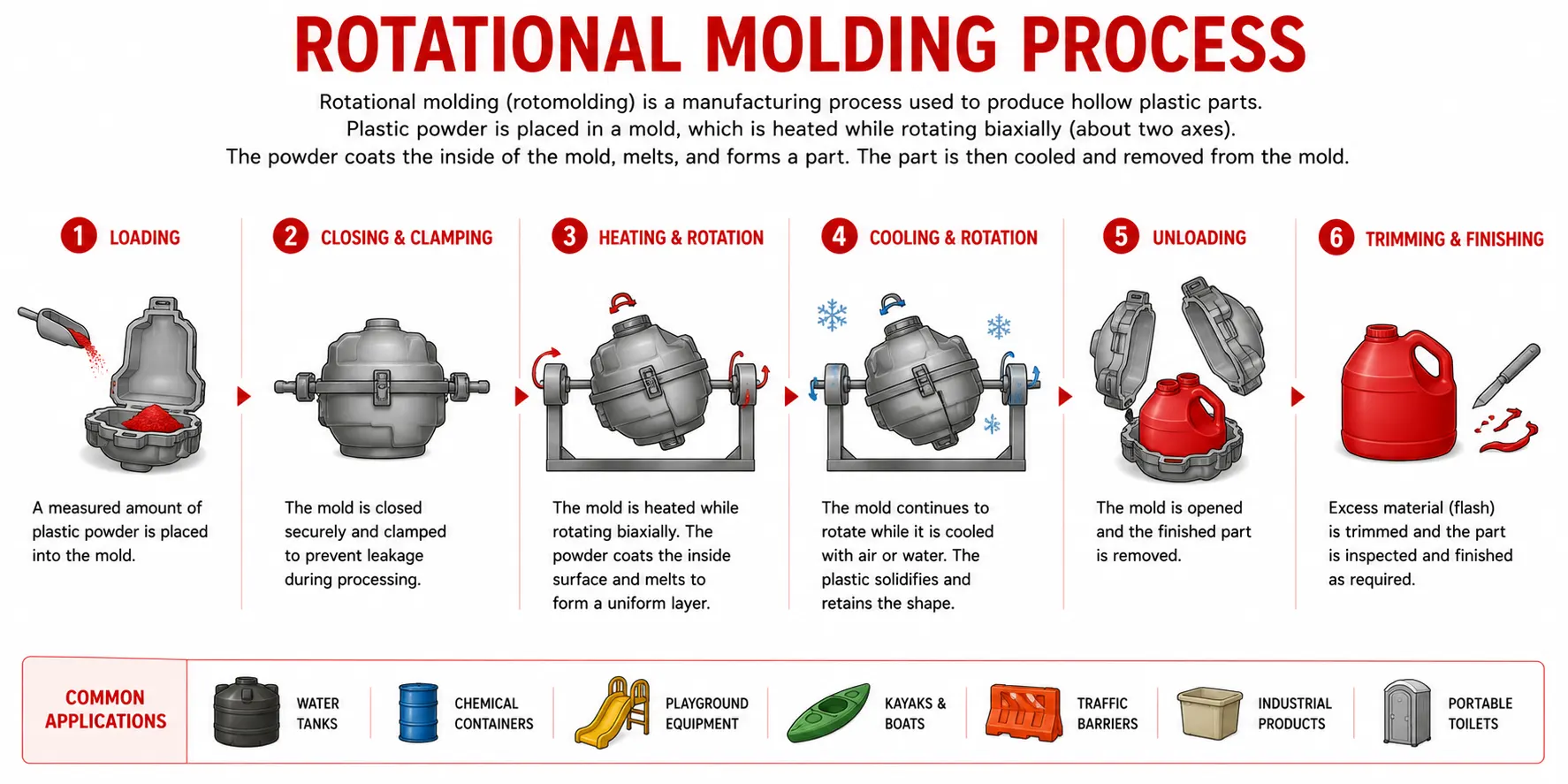
Rotational molding is a low-pressure plastic molding process primarily used to manufacture hollow plastic components.
A measured amount of plastic resin—typically in powdered form—is placed inside a hollow mold. The closed mold is heated while rotating around two axes. As the mold rotates, the resin melts and progressively coats the internal mold surfaces.
After the material has formed against the mold cavity, the mold continues rotating during a controlled cooling cycle. Once the plastic has sufficiently cooled and solidified, the finished rotational molded part is removed, trimmed and prepared for any required secondary operations or assembly.
The absence of the high molding pressures associated with processes such as injection molding allows rotational molding to produce relatively large and complex hollow components using comparatively economical tooling.
A typical custom rotational molding project includes four basic manufacturing stages:
A predetermined amount of powdered thermoplastic resin is loaded into the rotational mold. Material selection and charge weight are established based on the required part geometry, wall thickness, mechanical properties, environmental exposure and application.
The mold is heated while rotating around two perpendicular axes. The plastic powder gradually melts and coats the internal surfaces of the mold cavity.
Proper mold design, rotation, heating and processing parameters are important for achieving consistent material distribution throughout the component.
The mold continues rotating while it cools. Controlled cooling helps the material solidify while maintaining the desired geometry and dimensional stability.
After cooling, the molded component is removed from the tooling and can proceed to trimming, drilling, machining, assembly, welding, printing, labeling, inspection, packaging or other required secondary operations.
Rotomolding provides manufacturers and product designers with several important advantages.
Rotational molding can manufacture hollow components as a single molded piece, reducing the need to fabricate, weld or assemble multiple plastic sections.
Because rotational molding operates without the high cavity pressures required for injection molding, rotational molds and roto mold tooling can often be manufactured at a lower initial tooling investment than tooling for high-pressure molding processes.
This can make rotomolding attractive for prototype, low-volume and medium-volume programs as well as larger products for which conventional injection molding tooling could become prohibitively expensive.
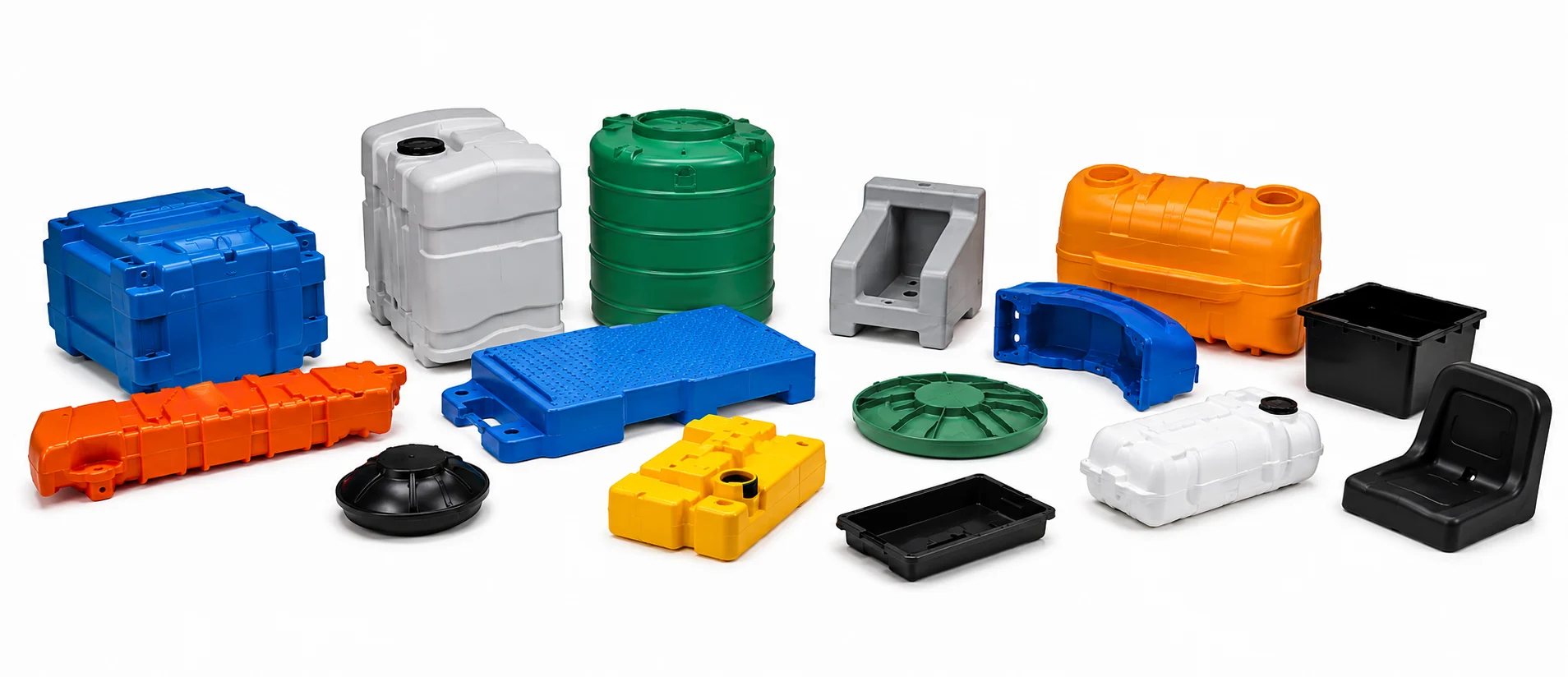
Rotational molding is particularly useful for manufacturing large hollow plastic parts such as tanks, housings, containers, bins, covers, enclosures and other industrial products.
The process can accommodate curves, contours, recesses, ribs, bosses, molded-in features and complex hollow geometries that may otherwise require several manufactured components and subsequent assembly.
Eliminating seams and joints can improve durability while reducing potential leakage points and assembly requirements.
Metal inserts, threaded components, fittings and other hardware can potentially be incorporated into rotational molded components when appropriately designed into the product and tooling.
Rotational molded components can be manufactured in a variety of colors and surface textures depending on resin, tooling and application requirements.
Plastic rotational molding can provide an alternative to fabricated metal products in applications where corrosion, moisture, chemicals or outdoor environmental exposure are concerns.
Successful rotational molding begins with properly engineered tooling.
Hi-Rel Plastics & Molding supports customers with rotational mold design and roto mold manufacturing as part of a complete custom manufacturing program. Mold design must account for part geometry, resin distribution, heating and cooling characteristics, parting lines, venting, shrinkage, demolding, inserts, surface requirements and production volume.
Depending on the product design and production requirements, rotational molds may be constructed from materials such as cast aluminum, CNC-machined aluminum or fabricated metal.
Our tooling and engineering approach focuses on creating molds designed not simply to produce the first acceptable sample, but to support reliable and repeatable production.
Customers requiring tooling for other manufacturing processes can also explore our mold and tool making services for injection molds, blow molds, LSR molds, thermoforming molds, vacuum forming molds and other custom tooling requirements.
Early DFM evaluation can prevent expensive changes after a rotational mold has already been manufactured.
Hi-Rel Plastics & Molding works with customers to review factors including:
For additional engineering information, see our Rotational Molded Plastic Part Design Guidelines.
Polyethylene is one of the most widely used material families for rotational molding because of its processing characteristics, toughness, chemical resistance and broad range of available grades.
Depending on application requirements, potential rotational molding materials may include:
Material selection should be based on the actual application rather than simply choosing a resin commonly used for rotomolding. Environmental exposure, operating temperature, chemical contact, impact resistance, stiffness, regulatory requirements, color, UV exposure and anticipated service life should all be considered.
Hi-Rel Plastics & Molding can work with customers and material suppliers to evaluate appropriate resin options for specific rotational molding applications.
Custom rotomolding can be used to manufacture products ranging from relatively simple containers to large, technically demanding OEM components.
Typical rotational molding applications can include:
Our engineering team can evaluate your CAD models, drawings, existing parts or product concepts to determine whether rotational molding is an appropriate manufacturing process.
Rotational molding can also provide an effective manufacturing solution for companies evaluating metal-to-plastic product conversion.
Replacing a fabricated metal assembly with a single rotational molded plastic component may help reduce product weight, eliminate corrosion, reduce the number of individual components, simplify assembly and provide additional design freedom.
Not every metal component is suitable for conversion to plastic. Mechanical loads, temperature, chemical exposure, stiffness, tolerances, regulatory requirements and long term product performance must be considered.
Hi-Rel Plastics & Molding can review the application and help determine whether rotational molding or another plastic manufacturing process provides a practical alternative.
Injection molding is generally best suited for producing repeatable plastic components at higher production volumes and can provide tight dimensional control and detailed molded features.
Rotational molding is often better suited for large, hollow and seamless components, especially when lower tooling investment or relatively modest production volumes are important.
Because Hi-Rel Plastics & Molding offers multiple molding technologies, customers can evaluate their application based on manufacturing requirements rather than being limited to a single process.
Both rotational molding and plastic blow molding are commonly used for hollow plastic products.
Blow molding can be highly efficient for bottles, containers and other hollow products requiring faster production cycles and larger production quantities.
Rotational molding can provide greater flexibility for much larger products, lower-volume programs and complex hollow components.
Hi-Rel Plastics & Molding can help customers determine which process provides the appropriate combination of tooling investment, production cost, geometry and anticipated production volume.
Thermoforming and vacuum forming shape heated plastic sheet over or into tooling and are commonly used for covers, trays, housings, panels and other open-shell products.
Rotational molding is typically preferred when the product requires an enclosed, hollow or seamless geometry.
Customers requiring large plastic components can have Hi-Rel Plastics & Molding evaluate rotational molding, thermoforming and vacuum forming before committing to tooling.
Identifying design problems before production tooling is manufactured can save significant development time and expense.
Our 3D printing and rapid prototyping capabilities can help customers evaluate part geometry, fit, assembly, ergonomics and other design characteristics before final rotational mold manufacturing.
This concept-to-production approach allows engineering, prototyping, tooling and production requirements to be considered together.
Hi-Rel Plastics & Molding provides a broad range of value-added secondary services to help customers consolidate manufacturing operations with fewer suppliers.
Depending on product requirements, available services include:
Integrating rotational molding, tooling and secondary operations with one manufacturing partner can reduce transportation, supplier management, work-in-process inventory and overall supply-chain complexity.
Hi-Rel Plastics & Molding Corp. operates under certified quality systems including ISO 9001:2015, ISO 13485:2016 and AS9100 Rev D, supporting customers in demanding medical, aerospace & defense, industrial and other regulated markets.
Hi-Rel Plastics & Molding also offers Class 10,000 / ISO Class 7 and Class 100,000 / ISO Class 8 cleanroom environments for qualifying manufacturing and assembly requirements.
Our quality and manufacturing capabilities support projects where documentation, process control, inspection, consistency and traceability are important elements of the supply relationship.
Hi-Rel Plastics & Molding provides custom plastic manufacturing solutions for major industries including:
Customers requiring multiple plastic manufacturing processes can consolidate projects through one supplier with capabilities in rotational molding, injection molding, medical clean room injection molding, liquid silicone rubber (LSR) molding, blow molding, thermoforming, vacuum forming, mold manufacturing, prototyping and secondary operations.
Located in Riverside, California, Hi-Rel Plastics & Molding Corp. provides custom rotational molding and roto mold manufacturing services for customers throughout Los Angeles, Orange County, Inland Empire, Southern California, Northern California and across the United States.
Working with a California plastics manufacturer can simplify engineering communication, tooling development, sampling, quality reviews and production support for West Coast OEMs while still providing nationwide manufacturing support.
Whether your company needs a new rotational mold, a new custom rotomolded product, an existing product redesigned for rotational molding or assistance determining whether another plastic manufacturing process is more suitable, our team can review your project requirements.
Hi-Rel Plastics & Molding provides customers with more than simply rotational molded parts. Our broad manufacturing capabilities support projects from concept through finished production.
Key capabilities include:
Looking for a custom rotational molding company, rotomolding manufacturer or rotational mold manufacturer for your next project?
Hi-Rel Plastics & Molding can evaluate new product designs, existing rotational molds, metal-to-plastic conversion opportunities and custom plastic components.
For the most accurate project evaluation, provide available 2D drawings, 3D CAD files, material requirements, estimated annual quantities, application information, dimensional requirements and any special assembly or secondary-operation requirements.
Contact Hi-Rel Plastics & Molding to discuss your rotational molding and roto mold manufacturing project.
Even material distribution ensures consistent strength throughout the part.
Low-pressure process reduces internal stress and enhances longevity.
Ideal for producing oversized or intricate hollow components.
Lower tooling costs compared to other molding methods for large parts.
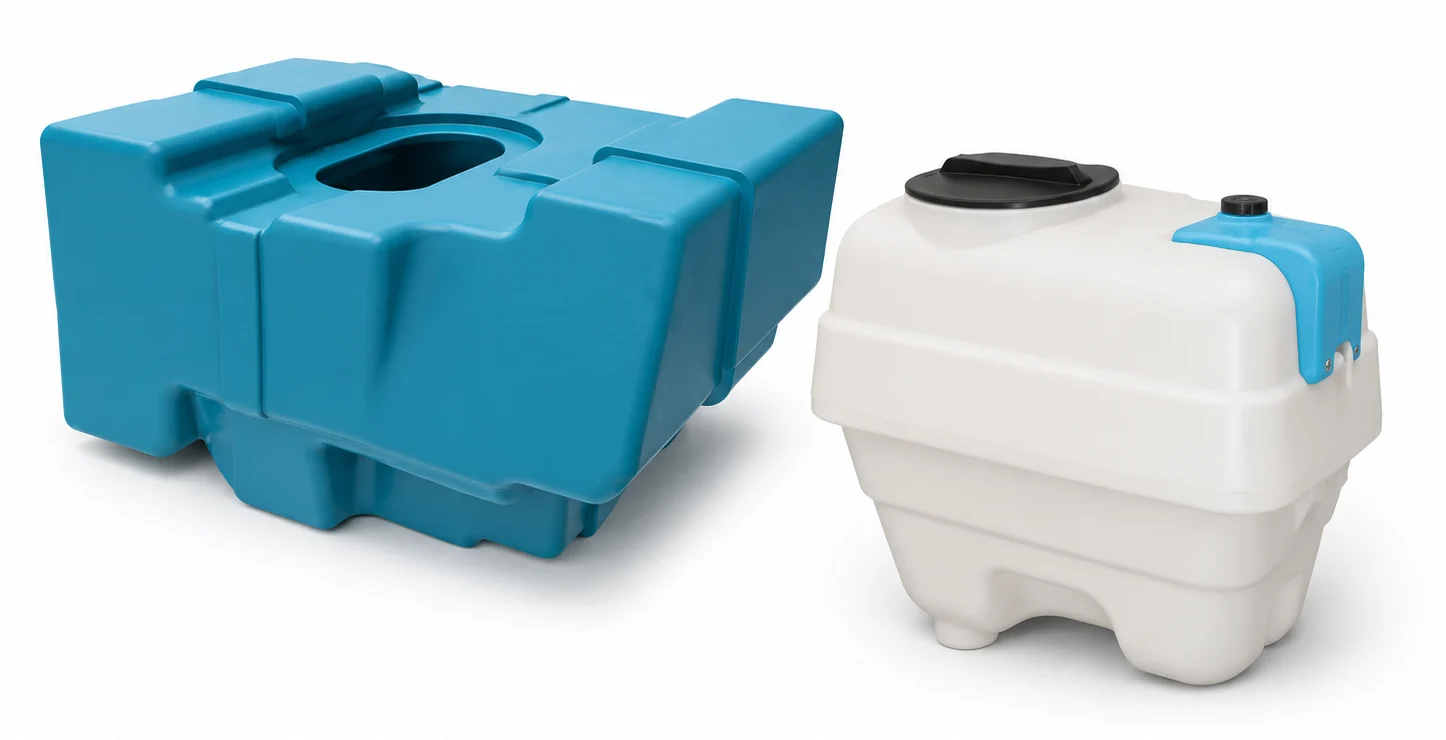
Hi-Rel Plastics & Molding works with customers to develop custom rotational molded plastic parts for demanding industrial and commercial applications.
Our rotational molding capabilities can support:
Our engineering-focused approach helps customers determine whether rotational molding, injection molding, blow molding, thermoforming or vacuum forming provides the best combination of tooling investment, production quantity, geometry, material performance and finished-part cost.
A successful rotational molded product begins with properly engineered tooling. Hi-Rel Plastics & Molding supports roto mold manufacturing, rotational mold manufacturing, mold design and tooling development as part of a complete manufacturing program.
Customers can work with one manufacturing partner from product development through mold construction, sampling and production.
Our plastic manufacturing capabilities support product development and production requirements including:
By considering the molding process during the design and tooling stages, our team can help identify opportunities to improve material distribution, part release, wall design, structural performance and manufacturing efficiency.
Rotomolding offers significant design flexibility, but good rotational molding DFM remains critical to obtaining consistent, economical parts.
During project evaluation, considerations can include:
Wall Thickness
Rotational molding is particularly well suited for hollow components requiring durable walls. Part geometry, resin flow and mold design influence material distribution throughout the component.
Corner Radii
Generous radii can improve material flow and help achieve more consistent material distribution in corners and transitions.
Draft
Appropriate draft helps the finished rotational molded part release efficiently from the mold.
Ribs and Structural Features
Properly designed ribs, kiss-offs and other molded structural features can improve rigidity without unnecessarily increasing overall part weight.
Molded-In Features
Depending on the application, inserts, threads, mounting points and other functional features may be incorporated into the product or added through secondary operations.
Part Geometry
One of the principal benefits of rotational molding is its ability to manufacture large and complex hollow shapes that may be difficult or costly to manufacture using other plastic molding technologies.
Early DFM collaboration helps determine the most practical combination of geometry, tooling, material and manufacturing process before significant tooling investments are made.
Material selection is critical to the performance of any rotational molded plastic component. Polyethylene is widely used in rotational molding because of its processability, durability and broad range of available properties.
Depending on the product design, operating environment and performance requirements, potential rotational molding materials may include:
Material selection should consider impact resistance, chemical exposure, temperature, UV exposure, stiffness, environmental conditions, appearance, regulatory requirements and cost.
Hi-Rel Plastics & Molding can assist customers in evaluating material options based on the functional requirements of the finished component.
Rotational molding can provide important advantages for appropriately designed products.
Large and Complex Hollow Parts
Rotomolding can manufacture large hollow plastic components without requiring the high injection pressures associated with conventional injection molding.
Seamless Construction
Many products can be molded as a single hollow component, reducing the need for joining multiple separately manufactured pieces.
Lower Tooling Investment for Certain Applications
Because the process operates at relatively low pressure, rotational molds may be less costly than comparable large injection molding tools, depending on part design and production requirements.
Design Flexibility
Complex shapes, contours, double walls, molded-in features and large enclosed geometries can often be incorporated into the design.
Durable Plastic Components
Appropriate material selection can provide excellent impact resistance, corrosion resistance, chemical resistance and outdoor durability.
Economical Low- and Medium-Volume Manufacturing
Rotational molding can be particularly attractive when annual quantities do not justify the tooling investment associated with a very large injection mold.
Choosing between rotational molding and injection molding depends on part geometry, size, tolerance requirements, production volume, material and tooling budget.
Plastic injection molding is generally well suited for high-volume production, precision components, tighter dimensional requirements and complex smaller parts.
Rotational molding is particularly useful for large, hollow and seamless components, especially when production volumes make large injection molding tooling difficult to justify.
Because Hi-Rel Plastics & Molding supports multiple plastic manufacturing processes, our team can evaluate the project rather than attempting to fit every component into a single manufacturing technology.
Both rotational molding and blow molding can manufacture hollow plastic products, but the processes serve different production requirements.
Blow molding is often advantageous for higher-volume hollow components such as bottles, containers, reservoirs and packaging. Hi-Rel Plastics & Molding supports extrusion blow molding (EBM), injection blow molding (IBM) and injection stretch blow molding (ISBM).
Rotational molding can be better suited to much larger hollow products, heavier-wall components, complex shapes and applications where production volumes favor lower pressure rotational tooling.
Our multi-process manufacturing expertise helps OEMs evaluate the most appropriate technology based on part size, annual volume, tooling budget, geometry, material and performance requirements.
Thermoforming and vacuum forming use heated plastic sheet that is formed over or into tooling, making these processes attractive for panels, covers, trays, liners and large relatively thin-wall components.
Rotational molding instead forms a hollow component by distributing resin around the internal surface of a heated rotating mold.
Customers requiring large plastic products can work with Hi-Rel Plastics & Molding to evaluate rotational molding, thermoforming and vacuum forming before committing to production tooling.
Production molding is only one stage of manufacturing a finished product. Hi-Rel Plastics & Molding offers value-added secondary services and assembly operations to help customers reduce the number of suppliers involved in their programs.
Available services can include:
Combining molding, machining, assembly and finishing through one manufacturing partner can simplify purchasing, improve communication and reduce supply-chain complexity.
Hi-Rel Plastics & Molding Corp. is ISO 13485 certified and supports manufacturers serving medical, healthcare, pharmaceutical and life-science markets.
For applications requiring controlled manufacturing environments, Hi-Rel Plastics & Molding also offers medical device injection molding and related manufacturing in Class 10,000 / ISO Class 7 cleanroom environments and Class 100,000 / ISO Class 8 cleanroom environments, along with clean room assembly capabilities.
This broader manufacturing infrastructure makes Hi-Rel Plastics & Molding an attractive supplier for companies that source multiple types of molded plastic components rather than rotational molded parts alone.
Rotational molding can be considered for aerospace, defense and transportation applications involving lightweight housings, protective cases, containers, ducting, fluid management products and other large plastic components.
Hi-Rel Plastics & Molding’s broader precision manufacturing capabilities provide customers with access to multiple plastic molding processes and quality-focused manufacturing from a single supplier.
Consumer-product manufacturers can use rotational molding for durable products including:
Rotomolding’s ability to manufacture durable hollow shapes makes it particularly useful for products that need impact resistance and outdoor performance.
Rotational molded products can also be used for selected food processing, beverage, packaging, storage and material-handling applications where suitable materials and manufacturing requirements are specified.
Potential applications include bulk containers, material-handling bins, ingredient containers, storage products, carts and processing-equipment components.
Material, sanitation and regulatory requirements should be evaluated for each specific application.
Rotational molding is especially well suited to rugged agricultural and industrial products. Applications can include:
Hi-Rel Plastics & Molding already supports molded plastic components for agricultural and farming equipment, including rotational molded water-storage tanks and bulk-material containers.
Rotational molding can support long-life products intended for repeated use. Durable containers, tanks, bins and material-handling products can reduce the need for frequent replacement.
Hi-Rel Plastics & Molding supports applications in sustainability and renewable markets, including rotational molded water-storage tanks, recycling bins, compost containers, environmental containment systems, utility carts and infrastructure components.
Where appropriate, material selection, product durability, component weight and end-of life considerations can be evaluated during product development.
A major advantage of working with Hi-Rel Plastics & Molding is access to far more than a standalone rotomolding operation.
Our manufacturing capabilities include:
This range of processes allows OEMs to source different components of an assembly or product family through a single-source plastic contract manufacturing partner.
Quality is integrated throughout the manufacturing process at Hi-Rel Plastics & Molding. Our quality systems support customers in demanding industries where repeatability, traceability and documented manufacturing controls are important.
Hi-Rel Plastics & Molding Corp. maintains ISO 13485:2016 certification for medical manufacturing programs and supports stringent quality requirements across medical, aerospace, industrial, consumer and other markets.
From tooling and material selection through molding, inspection, secondary operations and assembly, our goal is consistent manufacturing performance throughout the life of the program.
Companies searching for a rotational molding company in Los Angeles, roto molding company in Southern California, custom rotomolding manufacturer in California or rotational mold manufacturer near Los Angeles can work with Hi-Rel Plastics & Molding for complete project support.
Located in Riverside, California, Hi-Rel Plastics & Molding serves OEMs and manufacturers throughout:
Los Angeles, Riverside, San Bernardino, Orange County, San Diego, Ventura, Santa Barbara, Inland Empire and surrounding Southern California manufacturing markets.
Hi-Rel Plastics & Molding also supports manufacturers throughout Northern California, including companies in San Francisco, San Jose, Silicon Valley, Oakland, Sacramento and surrounding manufacturing markets.
Whether your company needs a new rotational molding program, roto mold manufacturing, an existing tooling transfer or a supplier capable of supporting several different plastic manufacturing technologies, our team can evaluate your requirements.
Our manufacturing services are not limited to California. Hi-Rel Plastics & Molding works with OEMs, engineering teams, purchasing departments and product manufacturers throughout the United States.
Customers can consolidate product development, mold manufacturing, rotational molding, other plastic molding processes, secondary operations and assembly through a single manufacturing resource.
Customers choose Hi-Rel Plastics & Molding for more than the molding process itself. Our advantages include:
Rather than managing separate suppliers for tooling, molded components, machining, assembly and finishing, customers can work with Hi-Rel Plastics & Molding to develop a streamlined manufacturing solution.
What is rotational molding?
Rotational molding, also known as rotomolding or roto molding, is a manufacturing process used primarily to produce hollow plastic components. Plastic resin is placed inside a mold that is heated and rotated around multiple axes, allowing the melted resin to coat the interior mold surface and form the finished component.
What types of parts can be rotationally molded?
Rotational molding can manufacture tanks, containers, housings, bins, carts, enclosures, outdoor products, agricultural components, material-handling products and many other large or complex hollow plastic parts.
What plastics are commonly used for rotational molding?
Polyethylene materials such as LLDPE and HDPE are among the most widely used rotational molding materials. Other specialty materials may be available depending on product performance and processing requirements.
Does Hi-Rel Plastics & Molding manufacture roto molds?
Yes. Hi-Rel Plastics & Molding supports rotational mold manufacturing and tooling development as part of complete custom rotational molding programs.
Is rotational molding suitable for low-volume production?
Rotational molding can be an excellent option for low- and medium-volume large plastic products because tooling requirements can be more economical than large high-pressure injection molding tools, depending on the application.
What is the difference between rotomolding and blow molding?
Both manufacture hollow plastic products. Blow molding typically uses air pressure to expand a molten parison or preform against a mold cavity, while rotational molding uses heat and multi-axis mold rotation to distribute resin along the inside of the mold.
Can rotational molded parts include inserts?
Depending on product design and tooling, inserts and other functional features may be incorporated into rotational molded components or installed using secondary manufacturing operations.
Do you provide secondary operations?
Yes. Hi-Rel Plastics & Molding provides machining, trimming, assembly, ultrasonic welding, heat insertion, heat staking, decorating, printing, labeling, bonding, painting, coating, inspection, packaging and other value-added secondary operations.
Can you help determine whether rotational molding is the best process?
Yes. Because Hi-Rel Plastics & Molding offers rotational molding as well as injection molding, blow molding, thermoforming and vacuum forming, our team can evaluate part geometry, quantity, tooling requirements, material and performance requirements to help identify an appropriate manufacturing process.
Do you serve customers outside California?
Yes. Hi-Rel Plastics & Molding serves OEMs and manufacturers throughout Southern California, Northern California, the Los Angeles region and across the USA.
Whether you are developing a new product, transferring an existing rotational mold, comparing manufacturing processes or looking for a custom rotational molding company and roto mold manufacturer, Hi-Rel Plastics & Molding can support your project from concept through production.
Send your 3D CAD files, drawings, material specifications, annual quantities and application requirements so our team can evaluate the project and recommend an appropriate manufacturing approach.
Contact Hi-Rel Plastics & Molding Corp. to discuss your custom rotational molding, roto mold manufacturing, plastic component manufacturing, assembly and secondary-service requirements.
Rotational molding, also known as rotomolding, is a manufacturing process used to produce hollow, seamless plastic parts by heating and rotating a mold filled with powdered thermoplastic material. As the mold rotates on multiple axes inside an oven, the material evenly coats the interior surfaces of the mold and gradually forms a uniform hollow part. Once cooled, the finished component is removed from the mold with excellent wall consistency, durability, and structural integrity. The process is ideal for producing large, complex, and stress-free hollow components with low tooling costs and flexible design capability.
Even material distribution ensures consistent strength throughout the part.
Low-pressure process reduces internal stress and enhances longevity.
Ideal for producing oversized or intricate hollow components.
Lower tooling costs compared to other molding methods for large parts.