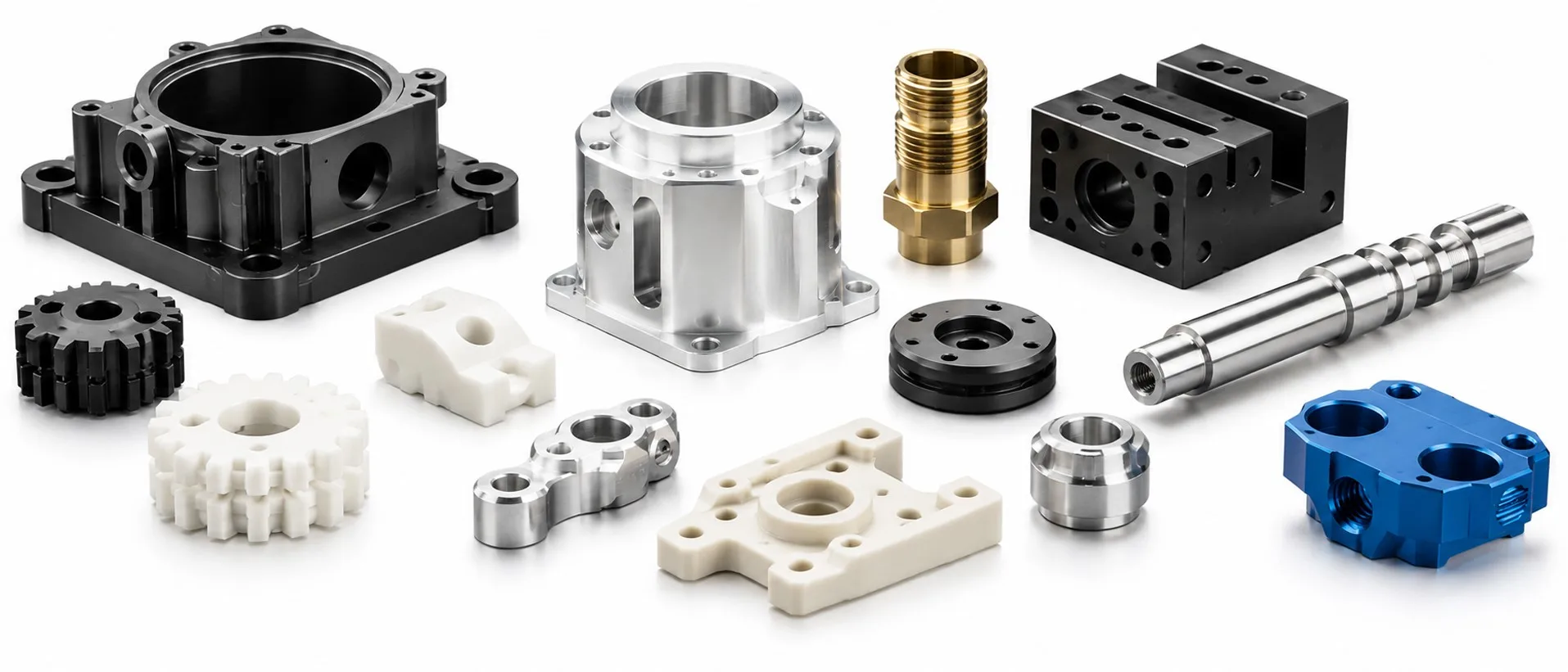
Hi-Rel Plastics & Molding Corp. provides precision plastic and metal CNC machining services for custom components, prototypes, secondary-machined molded parts, tooling components, fixtures, assemblies, and production applications throughout California and across the United States.
Our CNC machining capabilities complement Hi-Rel Plastics & Molding’s extensive plastics manufacturing operations, allowing customers to combine machining with plastic injection molding, medical clean room injection molding, blow molding, thermoforming, vacuum forming, rotational molding, mold and tooling manufacturing, engineering, prototyping, assembly, and other secondary operations.
As an ISO 9001, AS9100 and ISO 13485 certified manufacturer, Hi-Rel Plastics & Molding supports demanding OEM manufacturing programs for medical, aerospace and defense, automotive and electric vehicles, electronics, industrial equipment, research and laboratory equipment, consumer products, and other industries.
Whether your project requires a stand-alone CNC-machined plastic or metal component, a functional prototype, or precision secondary machining of a molded plastic part, Hi-Rel Plastics & Molding can support your project from concept through production.
CNC machining is a computer-controlled subtractive manufacturing process used to remove material from plastic or metal stock to create precision components and dimensional features.
Depending on part design and manufacturing requirements, CNC machining can produce features such as:
CNC machining is particularly useful when a component requires precision features or geometries that cannot be efficiently produced through molding alone.
Hi-Rel Plastics & Molding can support CNC machining for prototypes, product development, low-volume production, secondary machining, tooling components, fixtures, replacement components, and ongoing production requirements.
Hi-Rel Plastics & Molding provides precision plastic CNC machining for custom components and secondary manufacturing applications.
Machined engineering plastics can provide useful properties such as low weight, corrosion resistance, chemical resistance, electrical insulation, low friction, wear resistance, and dimensional performance depending on the selected material.
Potential CNC-machined plastic components include:
Plastic machining requires different manufacturing considerations than metal machining because polymer materials can respond differently to heat, cutting forces, clamping pressure, moisture, and internal stresses.
Material selection and machining strategy should therefore be evaluated according to the specific resin, component geometry, tolerance requirements, environmental conditions, and end-use application.
Hi-Rel Plastics & Molding has extensive experience working with engineering thermoplastics through our broader plastics manufacturing operations.
Depending on project requirements and material availability, potential CNC-machined plastic materials may include:
Every polymer behaves differently during machining.
Important considerations can include thermal expansion, heat generation, moisture absorption, rigidity, dimensional stability, cutting forces, internal stresses, fixturing, and finished surface requirements.
Hi-Rel Plastics & Molding can evaluate material requirements based on the mechanical, thermal, chemical, electrical, dimensional, and manufacturing needs of the application.
Hi-Rel Plastics & Molding also provides custom metal CNC machining services for qualifying components.
Machined metal parts can be supplied as individual components or incorporated into assemblies containing injection molded or machined plastic components.
Potential metal CNC machining applications include:
The appropriate metal, machining process, tolerances, and production strategy depend on component geometry, mechanical requirements, quantities, specifications, and end-use conditions.
CNC milling uses computer-controlled rotating cutting tools to remove material from a stationary workpiece.
CNC milling can produce features including:
CNC milling can support both plastic and metal components and is useful for prototypes, fixtures, custom machine components, secondary operations, tooling components, and production parts.
CNC turning is commonly used for cylindrical and rotationally symmetrical components. Potential CNC-turned components include:
Depending on the component geometry, CNC turning can be combined with additional machining operations to create the required finished part.
One of Hi-Rel Plastics & Molding’s most important advantages is our ability to combine plastic injection molding with secondary CNC machining.
Our Plastic Injection Molding Services support prototype, low-, medium-, and high-volume production using a broad range of thermoplastic materials.
Injection molding efficiently produces repeatable molded geometry, but certain products require secondary precision features that may be difficult or uneconomical to incorporate directly into the mold.
Secondary CNC machining can potentially add:
This hybrid manufacturing approach can be particularly effective when most of a component is efficiently injection molded while selected precision features are CNC machined afterward.
By performing molding and secondary operations through one manufacturing partner, customers can reduce supplier transfers, handling, transportation, and manufacturing coordination.
Hi-Rel Plastics & Molding can also integrate machining and trimming operations with our Plastic Blow Molding Services.
Blow molded bottles, containers, reservoirs, ducts, tanks, and technical hollow components can require post-molding features such as:
Hi-Rel Plastics & Molding provides extrusion blow molding, injection blow molding, and injection stretch blow molding along with secondary operations, assembly, and packaging.
Thermoformed and vacuum-formed plastic products frequently require secondary trimming and machining after forming.
Our thermoforming and vacuum forming capabilities can be combined with CNC machining to produce features such as:
This manufacturing combination can be particularly useful for equipment housings, covers, trays, panels, enclosures, and larger plastic components.
Rotationally molded products can also require precision post-molding operations. Potential secondary machining features include:
Hi-Rel Plastics & Molding can integrate appropriate secondary machining with rotational molding to provide components closer to their final assembled configuration.
CNC machining is an effective method for manufacturing functional prototypes directly from engineering plastics or metals.
Machined prototypes can help engineers evaluate:
CNC machining can be particularly useful when a prototype needs to be manufactured from a production-grade material before investment in production tooling.
Hi-Rel Plastics & Molding also provides 3D printing and rapid prototyping, allowing our engineering team to evaluate different prototype manufacturing approaches according to project requirements.
CNC machining and 3D printing both provide valuable options during product development.
CNC machining removes material from solid stock and can be appropriate when the project requires:
3D printing builds components layer by layer and can be especially useful for:
Because Hi-Rel Plastics & Molding offers both manufacturing methods, customers can select an appropriate prototyping strategy based on the purpose of each prototype.
CNC machining and injection molding serve different manufacturing requirements.
Hi-Rel Plastics & Molding can support customers as they transition from machined or 3D printed prototypes into production injection molding when quantities increase.
Hi-Rel Plastics & Molding can support customers throughout multiple stages of product development.
A typical manufacturing program can include:
Concept → Engineering → DFM → Prototype → CNC Machining → Mold Design → Mold Manufacturing → Production Molding → Secondary Machining → Assembly → Inspection → Packaging
This provides customers with manufacturing continuity as their products move from initial development into production.
CNC machining also plays an important role in tooling and manufacturing support.
Hi-Rel Plastics & Molding provides custom mold and tool manufacturing, including engineering, mold design, DFM, mold flow analysis, mold sampling, mold transfer, mold repair, and ongoing tooling support.
CNC machining can support qualifying:
Combining engineering, tooling, molding, machining, and secondary operations helps customers consolidate more of their manufacturing program with one supplier.
Machined components frequently become part of a larger mechanical or electromechanical assembly.
Our Assembly Services can integrate custom plastic and metal components with:
Additional secondary operations can include adhesive bonding, ultrasonic welding, heat insertion, heat staking, pad printing, labeling, surface finishing, inspection, and packaging.
CNC-machined or molded plastic components may require threaded metal inserts or other fastening features.
Our heat insertion and heat staking capabilities can be integrated with machining and molding for qualifying assemblies.
This can support products requiring:
Combining machining, insert installation, and assembly can reduce the number of outside suppliers required to complete a component.
Hi-Rel Plastics & Molding also provides Ultrasonic Insertion & Ultrasonic Welding Services.
Machined and molded plastic components can potentially move directly into joining and assembly operations when the product design and materials are suitable.
This provides OEMs with additional options for creating complete plastic assemblies rather than purchasing individual unfinished components.
Hi-Rel Plastics & Molding provides numerous secondary finishing and decorating operations that can be combined with CNC machining.
Available secondary services include:
Customers requiring printed identification or graphics can learn more about our Pad Printing Services.
Integrating machining and finishing helps customers receive components closer to their final production-ready condition.
Design for Manufacturability can have a significant impact on machining time, tooling access, setup requirements, material utilization, quality, and overall part cost.
Important CNC machining design considerations can include:
Hi-Rel Plastics & Molding’s engineering team can review customer CAD models and drawings to identify opportunities to improve manufacturability before production.
CNC machining can produce highly precise features when the material, component geometry, equipment, fixturing, process controls, and inspection methods are properly matched to the application.
Achievable machining tolerances depend on factors including:
Instead of applying one tolerance claim to every component, Hi-Rel Plastics & Molding evaluates each drawing and its critical dimensions individually.
Customers should provide dimensioned drawings identifying critical tolerances when requesting a CNC machining quotation.
Hi-Rel Plastics & Molding is ISO 13485 certified and supports medical-device, diagnostic, healthcare, pharmaceutical-related, research, and laboratory manufacturing programs.
Our Cleanroom Medical Injection Molding Services can be combined with custom machining, molding, assembly, and other secondary manufacturing operations.
Potential medical and laboratory CNC machining applications can include:
Hi-Rel Plastics & Molding offers both Class 10,000 / ISO Class 7 cleanroom environments and Class 100,000 / ISO Class 8 cleanroom environments for qualifying manufacturing and assembly programs.
The appropriate manufacturing environment depends on the product, manufacturing process, cleanliness requirements, intended use, and customer specifications.
Hi-Rel Plastics & Molding is AS9100 certified and supports aerospace and defense customers requiring quality-focused manufacturing and documentation.
Potential machined aerospace components can include:
CNC machining can be combined with molding, tooling, engineering, assembly, and other secondary operations to support more complete aerospace manufacturing programs.
Automotive and EV development frequently requires machined prototypes, fixtures, secondary-machined molded components, housings, brackets, and assembly components.
Hi-Rel Plastics & Molding can support qualifying applications including:
CNC machining can be particularly useful during development before production tooling is finalized.
Engineering plastics are widely used in electronics and electrical equipment because selected polymers can provide electrical insulation, low weight, chemical resistance, dimensional stability, and other useful performance characteristics.
Potential CNC machining applications include:
CNC machining can be combined with injection molding, pad printing, assembly, cable assembly, and other secondary operations for qualifying electronics programs.
Industrial equipment manufacturers frequently require custom machined plastic and metal components in quantities that may not justify dedicated production tooling.
Potential applications include:
CNC machining can be particularly valuable for replacement components, custom equipment, production fixtures, and lower-volume industrial applications.
Hi-Rel Plastics & Molding operates established quality management systems supporting demanding OEM manufacturing programs.
Our certifications include:
Customer-specific CNC machining programs can incorporate requirements for:
Our quality-focused approach extends beyond machining into tooling, molding, secondary operations, assembly, and finished-component manufacturing.
Hi-Rel Plastics & Molding provides customers with more than a stand-alone CNC machine shop.
Our capabilities include:
This broad manufacturing capability enables OEMs to source machined parts, molded components, secondary machining, tooling, assembly, finishing, and packaging through one manufacturing partner.
Hi-Rel Plastics & Molding is headquartered in Riverside, California and supports OEM customers throughout Southern California.
Our location allows us to serve companies searching for:
Customers can combine local engineering and manufacturing support with Hi-Rel Plastics & Molding’s broader molding, tooling, assembly, and secondary manufacturing capabilities.
Hi-Rel Plastics & Molding also supports OEM customers throughout Northern California, including the San Francisco Bay Area, Silicon Valley, San Jose, Sacramento, Oakland, Fremont, and surrounding manufacturing regions.
Customers throughout California can access our combination of CNC machining, custom plastic molding, engineering, tooling, secondary operations, assembly, and contract manufacturing.
Hi-Rel Plastics & Molding supports customers throughout the United States seeking domestic CNC machining and custom plastic manufacturing.
Whether your company needs a CNC-machined prototype, custom plastic component, metal component, secondary machining of an injection molded part, production tooling, or a complete turnkey manufacturing program, our team can evaluate your requirements.
Need a manufacturing partner capable of supporting your project from prototype and machining through molding, assembly, and production?
Contact Hi-Rel Plastics & Molding to discuss your CNC machining requirements.
For the most accurate quotation, please provide available 3D CAD files, 2D dimensioned drawings, material specifications, critical tolerances, surface-finish requirements, order quantities, estimated annual usage, secondary-operation requirements, assembly requirements, and applicable quality specifications.
Hi-Rel Plastics & Molding can review your project and determine how our CNC machining, plastics manufacturing, engineering, tooling, and secondary manufacturing capabilities can support your program.
Yes. Hi-Rel Plastics & Molding provides CNC machining for qualifying custom plastic and metal components. Material, geometry, tolerances, quantities, and application requirements are reviewed during quotation.
Yes. CNC machining can be used as a secondary operation to add precision holes, threads, slots, pockets, cutouts, mating surfaces, and other features to qualifying molded components.
Many engineering thermoplastics can be CNC machined, including materials such as ABS, acetal, nylon, polycarbonate, acrylic, polypropylene, polyethylene, PEEK, PPS, PEI, and other materials. Actual suitability depends on the specific material grade and part requirements.
Yes. CNC machining is frequently used for functional prototypes because parts can be machined directly from engineering plastic or metal stock without investing in production molding tooling.
Yes. Hi-Rel Plastics & Molding can support engineering, prototyping, DFM, mold design and manufacturing, sampling, injection molding, secondary operations, assembly, and production.
Secondary CNC machining is performed after another primary manufacturing operation, such as injection molding, blow molding, thermoforming, or rotational molding. It can add features that are difficult or inefficient to create during the primary manufacturing process.
Hi-Rel Plastics & Molding is ISO 13485 certified and supports qualifying medical, diagnostic, laboratory, and healthcare manufacturing programs. Manufacturing and cleanliness requirements are evaluated according to the individual application.
Hi-Rel Plastics & Molding is AS9100 certified and supports qualifying aerospace and defense manufacturing programs involving custom plastic and metal components, molded components, secondary operations, and assemblies.
For an accurate quote, provide a 3D CAD model when available, a dimensioned 2D drawing, material specification, critical tolerances, surface-finish requirements, quantity, annual usage, secondary operations, assembly requirements, and applicable quality specifications.
Machining processes designed to meet exact specifications and tight tolerances.
Flexible machining solutions for complex geometries and specialized components.
Support for a wide range of materials to meet diverse application needs.
Machining services integrated with molding processes for complete part solutions.