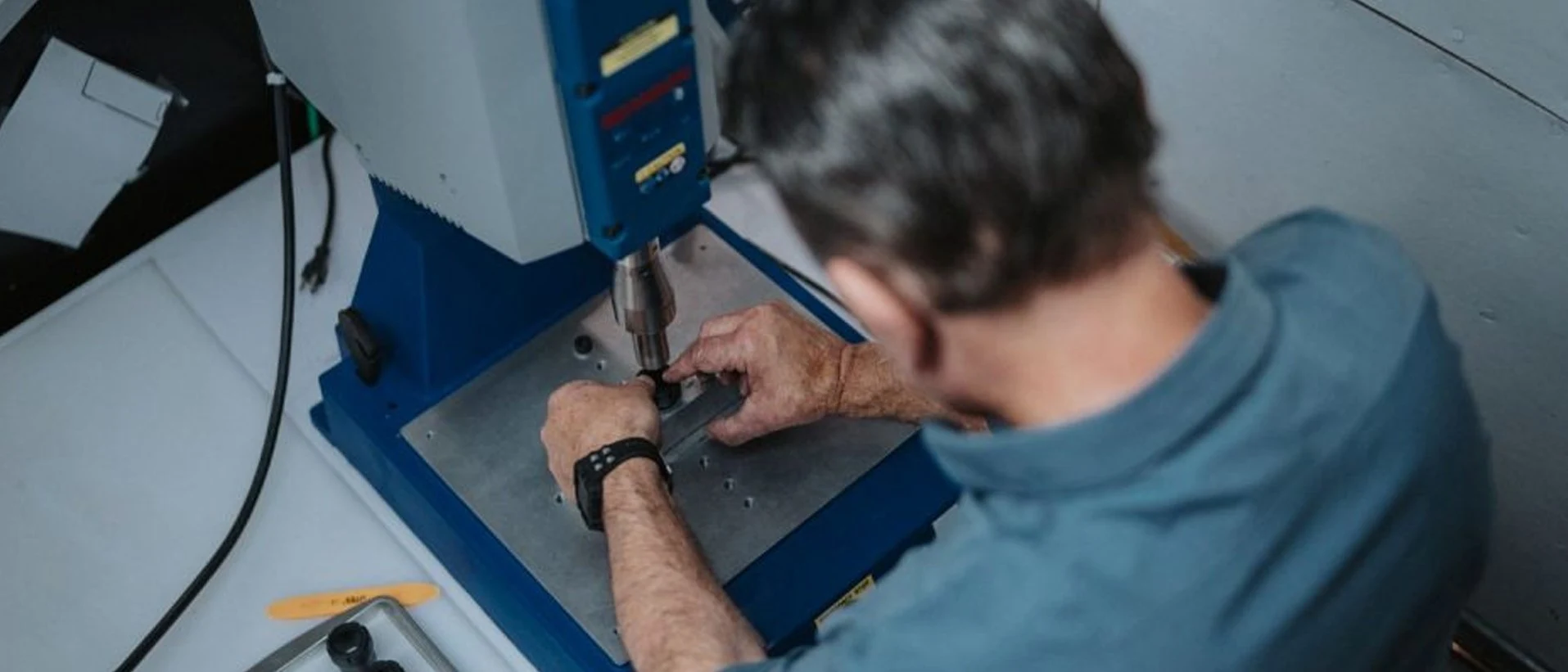
Hi-Rel Plastics & Molding Corp. provides precision plastic ultrasonic welding and ultrasonic insertion services for injection molded plastic components, housings, enclosures, assemblies, and other custom manufactured products throughout California and across the United States.
Ultrasonic technology can provide a fast and repeatable method for permanently joining compatible thermoplastic components or installing metal threaded inserts into molded plastic parts.
As an ISO 9001, AS9100 and ISO 13485 certified manufacturer, Hi-Rel Plastics & Molding can integrate ultrasonic welding and insertion directly with plastic injection molding, medical clean room injection molding, liquid silicone rubber injection molding, blow molding, mold and tooling manufacturing, CNC machining, mechanical assembly, cable assembly, printing, inspection, and custom packaging.
This integrated manufacturing approach allows customers to move from individual molded components to completed assemblies through one manufacturing partner.
Ultrasonic welding is a joining process that uses high-frequency mechanical vibration combined with controlled pressure to generate localized heat at the interface between compatible thermoplastic components.
The generated heat softens or melts material at the joint interface. When the vibration stops and pressure is maintained briefly, the plastic resolidifies and forms a permanent joint.
Ultrasonic welding can eliminate or reduce the need for:
The process can be particularly effective for high-volume plastic assemblies because welding cycles can be relatively fast and repeatable when the component, material, joint, tooling, and process are properly designed.
One of Hi-Rel Plastics & Molding’s strongest advantages is the ability to combine plastic injection molding and ultrasonic welding through one manufacturing partner.
Our Plastic Injection Molding Services manufacture custom plastic components for medical, aerospace, automotive, electronics, industrial, consumer, research, laboratory, and other applications.
After molding and inspection, qualifying components can move directly into ultrasonic welding and downstream assembly.
A complete manufacturing program can potentially include:
Consolidating these operations can reduce unnecessary transportation and coordination between separate molding, welding, and assembly suppliers.
An ultrasonic welding system generally uses a converter/transducer, booster, horn or sonotrode, fixture, and controlled press system.
During the welding cycle:
The resulting joint becomes an integrated plastic assembly.
Successful ultrasonic welding depends on component geometry, plastic material, joint design, energy transmission, tooling, amplitude, pressure, weld time, hold time, and other process variables.
Ultrasonic welding is primarily used with compatible thermoplastic materials because thermoplastics can soften or melt when heated and resolidify when cooled.
Potential materials can include:
However, not every combination of thermoplastic materials welds equally well.
Weldability can be influenced by:
The specific resin grade and component design should therefore be reviewed before selecting ultrasonic welding.
Joint design is one of the most important factors in successful ultrasonic welding.
A well-designed joint helps concentrate ultrasonic energy where the weld is intended to occur and can improve repeatability.
Potential joint considerations include:
Ultrasonic welding requirements should ideally be considered during the initial product and mold design rather than after production tooling has already been completed.
Hi-Rel Plastics & Molding can evaluate welding requirements during engineering and DFM activities.
An energy director is a small molded feature designed into the joint area of a thermoplastic component.
Its purpose is to concentrate ultrasonic energy into a controlled area at the beginning of the welding cycle.
As ultrasonic vibration is applied, the energy director begins to soften or melt and helps initiate formation of the welded joint.
Energy-director geometry depends on:
Because the energy director is typically molded directly into the component, it should be considered during part design and mold development.
Certain products require a joined plastic enclosure or container with controlled sealing performance.
Ultrasonic welding can potentially support sealed assemblies when the part geometry, joint design, materials, tooling, and process are developed appropriately.
Potential applications can include:
Where leak-tight or hermetic performance is required, the specific acceptance criteria and validation method should be defined by the customer.
Ultrasonic welding alone should not be assumed to create a hermetic seal without appropriate design and validation.
Ultrasonic welding and adhesive bonding can both join plastic components, but they operate differently.
Ultrasonic welding uses mechanical vibration and pressure to join compatible thermoplastic components.
Potential advantages can include:
Our Adhesive Bonding Services can join plastic-to-plastic, plastic-to-metal, and other compatible material combinations using an appropriate adhesive system.
Adhesive bonding can be useful when:
The appropriate joining process depends on material compatibility, component geometry, production volume, strength requirements, sealing requirements, appearance, and operating environment.
Mechanical fasteners such as screws can provide removable assemblies, but they also require additional hardware and assembly operations.
Ultrasonic welding can eliminate fasteners in qualifying applications and create a permanent assembly.
Mechanical fastening may remain preferable when:
Hi-Rel Plastics & Molding can evaluate ultrasonic welding, threaded inserts, heat staking, adhesive bonding, and mechanical fastening as part of the overall assembly strategy.
Hi-Rel Plastics & Molding also provides ultrasonic insertion of metal inserts into thermoplastic components.
Ultrasonic insertion uses high-frequency mechanical vibration to generate localized heat at the interface between a metal insert and the surrounding thermoplastic.
As the insert is driven into the prepared molded hole, the surrounding plastic softens and flows around the insert’s external features.
When the ultrasonic energy stops, the plastic resolidifies around the insert and mechanically locks it into position.
Threaded metal inserts provide reusable machine threads in plastic components.
They can be particularly useful when an assembly requires:
Potential applications include:
For appropriate thermoplastics, ultrasonic installation provides an efficient method for installing threaded inserts after molding.
The process can potentially be used with appropriate:
Insert selection depends on the plastic resin, thread size, required torque resistance, pull-out requirements, boss geometry, hole dimensions, component wall thickness, and assembly requirements.
The molded boss surrounding an insert has an important effect on assembly performance.
Important design considerations can include:
Incorrect boss or hole dimensions can cause problems such as cracking, inadequate retention, deformation, or inconsistent insert position.
For new injection molded products, Hi-Rel Plastics & Molding can review insert requirements before production tooling is finalized.
Both ultrasonic insertion and heat insertion can install metal threaded inserts into thermoplastic components.
Ultrasonic insertion uses high-frequency vibration to generate localized heat at the insert/plastic interface.
Heat Insertion & Heat Staking uses a heated installation tool to soften the thermoplastic around the insert.
Both methods can provide effective post-molding insert installation.
The appropriate method depends on:
Metal inserts can also be incorporated directly during injection molding.
With insert molding, the insert is positioned inside the mold before plastic injection. Plastic then flows around the insert during the molding cycle.
With ultrasonic insertion, the plastic component is molded first and the insert is installed afterward.
Each approach has advantages.
Insert molding can integrate the insert during production molding and eliminate a separate post-molding insertion step.
Post-molding insertion can provide flexibility in insert selection and keeps metal hardware out of the molding cavity during the initial molding operation.
Hi-Rel Plastics & Molding can evaluate the most appropriate manufacturing method based on part design, insert requirements, production quantities, tooling, automation, and cost.
Reliable ultrasonic welding requires proper support of the components during the welding cycle.
Fixtures help:
The ultrasonic horn must also match the product geometry and effectively transmit energy into the assembly.
Tooling requirements should therefore be considered part of the ultrasonic welding process rather than an afterthought.
Hi-Rel Plastics & Molding’s tooling and engineering capabilities allow welding and assembly requirements to be considered together with component manufacturing.
Hi-Rel Plastics & Molding provides custom Mold & Tool Manufacturing for plastic products.
Products intended for ultrasonic welding or insertion can require molded features such as:
Integrating these requirements during tooling development can reduce the risk of costly component modifications after the production mold is complete.
Hi-Rel Plastics & Molding provides engineering support, DFM, and 3D Printing & Rapid Prototyping to help customers evaluate product designs before production tooling.
Prototype assemblies can help evaluate:
Production-intent material and molded geometry should ultimately be evaluated when validating an ultrasonic welding process because prototype materials may behave differently from production molded thermoplastics.
Ultrasonic welding can be one step within a larger product assembly.
Our Assembly Services can integrate:
This allows customers to source complete subassemblies rather than individual molded components.
Electronic and electromechanical products can require plastic housings assembled around internal components, connectors, cables, or wire harnesses.
Hi-Rel Plastics & Molding can combine plastic molding and ultrasonic welding with mechanical and cable assembly for qualifying applications.
Potential programs can include:
Integrating molded housing production and downstream assembly can simplify the customer’s supply chain.
After molding and before or after assembly, products can also require identification or graphics.
Our Pad Printing Services can apply:
The appropriate manufacturing sequence depends on the product geometry and whether printing should occur before or after welding.
Completed welded assemblies can move into our Custom Packaging Services.
Packaging can potentially include:
Combining molding, welding, assembly, inspection, and packaging helps customers
reduce supplier complexity.
Hi-Rel Plastics & Molding is ISO 13485 certified and supports medical-device, diagnostic, laboratory, healthcare, and pharmaceutical-related manufacturing programs.
Ultrasonic welding can be useful for qualifying medical plastic assemblies because it does not require a liquid adhesive at the welded joint.
Potential applications can include:
Our Cleanroom Medical Injection Molding Services support qualifying medical manufacturing programs.
Hi-Rel Plastics & Molding offers both Class 10,000 / ISO Class 7 cleanroom environments and Class 100,000 / ISO Class 8 cleanroom environments.
The appropriate molding, welding, assembly, and packaging environment depends on the specific product, cleanliness requirements, intended use, and customer specifications.
Certain medical, diagnostic, pharmaceutical-related, and sensitive products require assembly within a controlled environment.
Hi-Rel Plastics & Molding’s cleanroom capabilities can support qualifying manufacturing and assembly programs requiring ISO Class 7 or ISO Class 8 environments.
Cleanroom requirements should be identified during quotation so that the complete manufacturing process can be evaluated.
Not every ultrasonic welding operation requires or is suitable for cleanroom processing.
Hi-Rel Plastics & Molding is AS9100 certified and supports Aerospace & Defense Manufacturing programs involving precision plastic and metal components.
Potential applications can include:
The appropriate joining method depends on resin, component geometry, mechanical requirements, environmental exposure, and customer specifications.
Ultrasonic welding is widely applicable to plastic housings and enclosures used in Electronics Manufacturing.
Potential products can include:
Ultrasonic insertion can also install threaded inserts used to attach circuit boards, covers, brackets, connectors, and other internal components.
Hi-Rel Plastics & Molding can combine molding, insert installation, ultrasonic welding, EMI/RFI coating, cable assembly, and final mechanical assembly for qualifying electronics programs.
Our Automotive & Electric Vehicle Manufacturing capabilities support molded components and assemblies for conventional and electric vehicles.
Potential ultrasonic welding applications can include:
Ultrasonic insertion can also provide threaded attachment points in molded automotive components.
Industrial products frequently require durable molded assemblies.
Potential applications can include:
Depending on the application, Hi-Rel Plastics & Molding can combine ultrasonic welding with threaded inserts, machining, mechanical assembly, printing, and packaging.
Hi-Rel Plastics & Molding operates under established quality management systems supporting demanding OEM production programs.
Our certifications include:
Learn more about our Quality Systems & Certifications.
Customer-specific ultrasonic welding programs can incorporate requirements for:
Inspection and validation requirements are developed according to the product and customer specifications.
Using one manufacturing partner for molding and welding can provide several advantages.
Customers can reduce dependence on separate molders, welding companies, assemblers, and packaging suppliers.
Components can move directly from molding into welding and assembly without unnecessary shipping between vendors.
Molded joint geometry, energy directors, insert bosses, and assembly features can be considered during product and tooling development.
Fewer supplier transfers can reduce unnecessary handling of cosmetic, medical, or precision components.
Molding and downstream assembly can be managed through a coordinated manufacturing and quality process.
Customers can receive welded, assembled, inspected, and packaged products rather than individual molded components.
Hi-Rel Plastics & Molding provides much more than a standalone ultrasonic welding operation.
Our manufacturing capabilities include:
This range of capabilities enables customers to move from engineering and tooling through molding, welding, insertion, assembly, inspection, and packaging through one California manufacturing partner.
Hi-Rel Plastics & Molding is located in Riverside, California and supports OEMs throughout Riverside, San Bernardino, the Inland Empire, Los Angeles, Orange County, San Diego, Southern California, Northern California, and across the United States.
Whether your project requires plastic ultrasonic welding, ultrasonic insertion, threaded insert installation, injection molded plastic assembly, medical plastic welding, electronics housing assembly, mechanical assembly, or complete contract manufacturing, our team can evaluate your requirements.
Need a manufacturing partner capable of molding your plastic components and providing ultrasonic welding, threaded insert installation, assembly, and packaging?
Contact Hi-Rel Plastics & Molding to discuss your project.
For an accurate quotation, provide available 3D CAD files, 2D drawings, plastic resin, component dimensions, joint design, insert specifications, assembly drawings, estimated production quantities, annual usage, welding requirements, sealing or leak-test requirements, torque or pull-out requirements where applicable, cosmetic requirements, and applicable quality specifications.
Our team can review your application and determine how Hi-Rel Plastics & Molding’s plastic molding, ultrasonic welding, insertion, and assembly capabilities can support your production program.
Hi-Rel Plastics offers ultrasonic insertion services to securely install metal or threaded inserts into plastic components. This process uses controlled ultrasonic energy to achieve strong, precise insert placement without damaging the surrounding material.
Ultrasonic insertion provides a reliable method for embedding inserts into plastic parts, improving strength and functionality while maintaining part integrity. Hi-Rel Plastics utilizes advanced equipment to ensure accurate positioning, consistent results, and long-term performance.
With experience across a range of materials and insert types, we help manufacturers produce durable components ready for assembly and use.
Ultrasonic energy ensures secure bonding and long-lasting insert stability.
Minimizes stress and damage to surrounding plastic components.
Controlled processes deliver accurate alignment and consistent results.
Fast, repeatable insertion suitable for high-volume manufacturing.