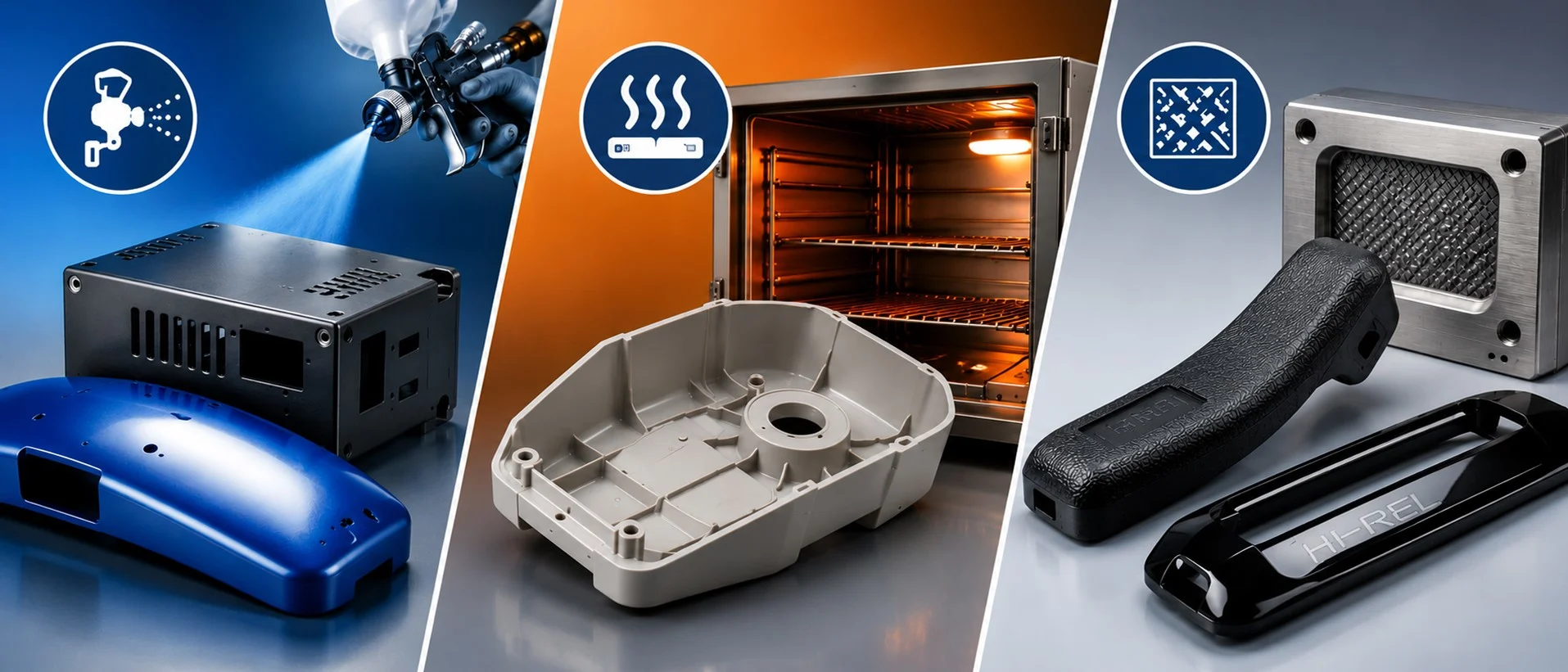
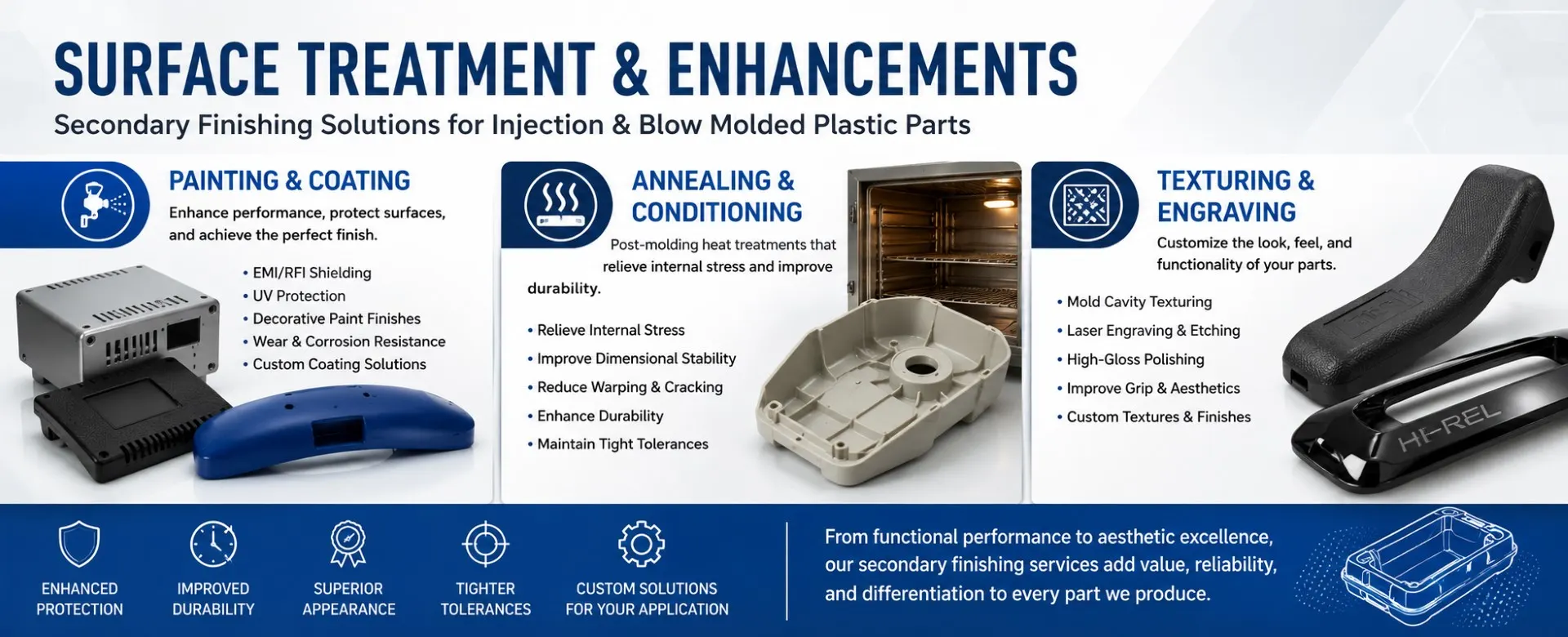
Hi-Rel Plastics & Molding Corp. provides comprehensive plastic surface treatment, coating, painting, annealing, texturing, engraving, and finishing services for custom molded components and assemblies throughout California and across the United States.
Surface finishing can improve the appearance, functionality, environmental resistance, dimensional stability, identification, and overall performance of a manufactured plastic component.
As an ISO 9001, AS9100 and ISO 13485 certified manufacturer, Hi-Rel Plastics & Molding can integrate surface treatment directly with plastic injection molding, medical clean room injection molding, blow molding, thermoforming, vacuum forming, rotational molding, CNC machining, assembly, decorating, inspection, and custom packaging.
This integrated manufacturing approach allows OEMs to move from an unfinished molded component to a coated, decorated, assembled, inspected, and packaged product through a single manufacturing partner.
Plastic components can require additional finishing after molding depending on their appearance, environment, functionality, and end-use requirements.
Hi-Rel Plastics & Molding supports a range of surface-treatment and finishing options for qualifying applications, including:
The correct process depends on the plastic resin, component geometry, surface condition, appearance requirements, operating environment, production quantity, and customer specifications.
Painting can improve both the appearance and functional performance of molded plastic components.
Depending on the application and confirmed coating system, plastic painting can potentially provide:
Plastic painting requires compatibility between the coating and the underlying polymer.
Factors that can influence coating performance include:
Hi-Rel Plastics & Molding evaluates these considerations for each application rather than assuming one coating system is appropriate for every plastic.
A major advantage of working with Hi-Rel Plastics & Molding is the ability to combine plastic injection molding with painting, coating, and surface finishing.
Our Plastic Injection Molding Services support precision molded components for medical, aerospace, automotive, electronics, industrial, consumer, and other markets.
The current injection molding operation already supports finishing and secondary processes including painting, coating, surface finishing, CNC machining, pad printing, ultrasonic welding, heat staking, assembly, and packaging.
After molding and inspection, qualifying components can move directly into downstream surface-finishing operations without being shipped to another supplier.
This can help reduce handling, transportation, and production coordination between multiple vendors.
Decorative coatings can enhance the appearance of molded plastic components and help products achieve specific branding or cosmetic objectives.
Decorative requirements can involve color, gloss level, texture, masking, appearance standards, and acceptable cosmetic criteria.
For products with demanding appearance requirements, Hi-Rel Plastics & Molding can coordinate molding, surface finishing, printing, assembly, and inspection within a complete manufacturing program.
Certain applications require surface coatings for more than appearance.
Protective coatings can potentially help improve resistance to environmental or service- related exposure depending on the coating system and substrate.
Project requirements may involve:
Actual performance depends on the specific coating, resin, surface preparation, application method, cure process, and operating environment.
Testing should be defined according to the requirements of the finished product when coating durability is critical.
Plastic products used outdoors or exposed to strong light may require additional protection against ultraviolet exposure.
Depending on the resin and product application, UV-resistant coatings can potentially supplement material-level UV stabilization and help protect appearance or surface performance.
Potential applications can include:
UV resistance should be evaluated as part of the complete material and coating system.
A coating should not be used as a substitute for proper resin selection when the underlying plastic must also withstand prolonged outdoor exposure.
Components that experience repeated handling, contact, rubbing, or abrasion may benefit from an appropriate protective surface treatment.
Potential applications can include:
The required coating or treatment depends on expected wear conditions and should be validated against the actual operating environment.
Plastic housings offer low weight, design flexibility, corrosion resistance, and manufacturing efficiency, but most conventional thermoplastics do not inherently provide the same electromagnetic shielding behavior as a metal enclosure.
For qualifying electronics and electrical applications, Hi-Rel Plastics & Molding can provide EMI/RFI shielding coatings as part of a molded plastic housing program.
EMI/RFI shielding can be relevant to applications such as:
Conductive coatings can be applied to appropriate surfaces of a plastic enclosure to help manage electromagnetic or radio-frequency interference according to customer requirements.
Shielding effectiveness depends on the complete enclosure design, coating system, coating thickness, grounding strategy, joints, seams, openings, connectors, and frequency range.
For this reason, Hi-Rel Plastics & Molding evaluates EMI/RFI coating requirements according to customer specifications rather than assigning one universal shielding value to every application.
Hi-Rel Plastics & Molding can combine plastic housing production with downstream shielding and assembly operations.
An integrated electronics-housing program can potentially include:
This can be particularly valuable for medical, aerospace, defense, electronics, communications, industrial, and automotive products containing electronic components.
Customers can learn more about our Electronics Manufacturing capabilities.
Hi-Rel Plastics & Molding also provides annealing and conditioning services for qualifying plastic components.
Molding and machining can introduce internal stresses into thermoplastic components. Depending on the material and application, a controlled heat-treatment cycle can help relieve residual stresses and improve dimensional stability.
Potential reasons for annealing can include:
The correct annealing process depends heavily on the polymer, component thickness, geometry, molded condition, and final application.
Annealing temperatures and cycles must therefore be developed for the specific material rather than applying one universal process.
Injection molded components can contain residual stresses caused by material flow, packing, cooling, wall-thickness transitions, molded-in features, and processing conditions.
Where appropriate, annealing may help stabilize a molded component before later machining, assembly, inspection, or use.
However, annealing should not be viewed as a substitute for proper mold design or optimized molding conditions.
Our engineering and molding teams can evaluate:
The best manufacturing solution often combines proper molding process development
with appropriate secondary conditioning when required.
Certain engineering polymers may require controlled conditioning to reach the desired state before final measurement or use.
Moisture-sensitive thermoplastics in particular can experience dimensional and property changes as they absorb moisture from their environment.
Where applicable, Hi-Rel Plastics & Molding can evaluate conditioning requirements according to material specifications and customer requirements.
This can be important for precision components used in:
Surface texture can influence both the appearance and function of a plastic product.
Potential reasons for specifying a texture can include:
Texture is often created in the mold surface itself, which means texturing requirements should ideally be defined before production tooling is finalized.
Hi-Rel Plastics & Molding provides mold and tooling manufacturing support and can coordinate customer-specified surface texture requirements during mold development.
A molded plastic surface reproduces the surface condition of the mold cavity.
This makes the mold an important part of the finished cosmetic appearance.
Potential mold-surface options can include:
Surface texture can also affect draft requirements and part ejection.
Deeper textures generally require additional draft compared with polished surfaces, so
texture requirements should be communicated during DFM and tooling development.
Our Mold & Tool Manufacturing capabilities can support the integration of surface-finish requirements into production tooling.
Injection molded components can also be produced using different mold-polishing and surface-finish levels depending on the required appearance.
Applications may range from highly polished cosmetic surfaces to matte or textured
finishes.
The selected finish should take into consideration:
Specific SPI or other standardized finish requirements should be identified on the engineering drawing or mold specification when they are critical.
Engraving can be incorporated into molds, tooling, or manufactured components to create permanent product features.
Potential engraved features can include:
Engraved features incorporated directly into the mold can become part of every molded component without requiring a separate printing operation.
For projects requiring additional graphics after molding, Hi-Rel Plastics & Molding also provides Pad Printing, Hot Stamping, and label application services.
Molded-in texture and post-molding coating can both alter the finished appearance of a plastic component, but they do so in different ways.
Texture is reproduced directly from the mold surface during injection molding.
Potential advantages include:
A coating is applied after the part is molded.
This can provide:
Some products may use both a molded texture and a coating.
The correct approach depends on product appearance, performance, volume, cost, and environmental requirements.
Surface enhancement also includes product decoration and identification.
Hi-Rel Plastics & Molding provides multiple decorating options:
Our Pad Printing Services can apply logos, symbols, text, operating indicators, and custom graphics to flat, curved, recessed, or irregular surfaces.
Our Hot Stamping Services can apply foil-based logos, lettering, metallic decorative effects, and other qualifying graphics.
Labels can provide product identification, warnings, barcodes, branding, and customer-specific information.
Providing multiple finishing options allows Hi-Rel Plastics & Molding to evaluate the best available method based on product geometry, graphic requirements, appearance, and production volume.
Our Plastic & Metal CNC Machining Services can also be combined with surface finishing.
Machined or molded components may require downstream operations such as:
Combining machining and finishing can simplify sourcing for custom plastic and metal components.
Surface treatment is frequently one operation in a larger finished-product manufacturing program.
Our Assembly Services can integrate finished components with:
The manufacturing sequence can be developed according to the coating, decoration, masking, assembly, and finished-product requirements.
Surface condition can also influence adhesive performance.
Our Adhesive Bonding Services can support appropriate plastic-to-plastic, plastic-to-metal, and multi-material assemblies.
Adhesive performance may depend on:
Where a product requires both coating and adhesive bonding, the manufacturing sequence should be evaluated carefully to avoid compatibility problems between the finish and bond area.
Cosmetic and coated plastic components can require careful handling after finishing.
Our Custom Packaging Services can help protect appearance-sensitive components during storage and shipment.
Potential packaging considerations can include:
This can be especially important for painted, coated, polished, decorated, transparent, or high-gloss components.
Hi-Rel Plastics & Molding is ISO 13485 certified and supports medical-device, diagnostic, laboratory, healthcare, and pharmaceutical-related manufacturing programs.
Our Cleanroom Medical Injection Molding capabilities include both Class 10,000 / ISO Class 7 and Class 100,000 / ISO Class 8 cleanroom environments for qualifying manufacturing and assembly programs.
Potential medical finishing applications can involve:
The coating, printing, finishing, and manufacturing environment must be evaluated according to the actual medical product, material, intended use, and customer requirements.
Not every surface-treatment process is appropriate for cleanroom processing.
Hi-Rel Plastics & Molding is AS9100 certified and supports aerospace and defense programs requiring precision plastic and metal components.
Our Aerospace & Defense Manufacturing capabilities can incorporate molded components, CNC machining, finishing, printing, assembly, and other secondary operations.
Potential applications can involve:
Finishing requirements are developed according to the material, drawing, environmental conditions, appearance standards, and customer specifications.
Electronics is an important market for surface-finishing services because plastic housings often require both cosmetic and functional treatments.
Our Electronics Manufacturing capabilities can support:
Potential secondary operations can include EMI/RFI shielding coatings, painting, pad printing, label application, threaded inserts, ultrasonic welding, machining, and final assembly.
Automotive and EV products frequently require both cosmetic and functional plastic finishes.
Potential components include:
Hi-Rel Plastics & Molding can combine Automotive & Electric Vehicle manufacturing with molding, surface finishing, printing, assembly, and other secondary operations for qualifying programs.
Industrial equipment can require finishes that support appearance, identification, handling, or environmental performance.
Potential applications include:
The correct surface finish is selected according to the application’s functional and environmental requirements.
Appearance is particularly important for consumer products, cosmetics, personal-care products, appliances, and other customer-facing products.
Surface finishing can provide:
Combining molding, finishing, decorating, and assembly helps Hi-Rel Plastics & Molding provide more complete finished products.
Surface requirements should ideally be considered early in product development.
Important factors can include:
Our engineering team can evaluate these considerations during DFM and mold-development activities.
This can help reduce costly modifications after production tooling is complete.
Hi-Rel Plastics & Molding operates under quality management systems supporting demanding OEM production programs.
Our certifications include:
Learn more about our Quality systems and certifications.
Customer-specific finishing programs can incorporate requirements for:
Process controls are developed according to the specific material, finish, product, and customer requirements.
Using one manufacturing partner for molding and finishing can provide several advantages.
Customers can reduce dependence on separate molders, coating companies, decorators, assemblers, and packaging suppliers.
Parts can move directly from molding into finishing and assembly without unnecessary transportation between vendors.
Tooling, molding, coating, printing, assembly, inspection, and packaging can be coordinated within one production program.
Fewer supplier transfers can help reduce handling of cosmetic or precision parts.
A coordinated quality process can support both component manufacturing and downstream finishing.
Customers can receive coated, decorated, assembled, inspected, and packaged products rather than unfinished molded parts.
Hi-Rel Plastics & Molding provides much more than a standalone coating or finishing operation.
Our manufacturing capabilities include:
This range of capabilities allows customers to move from engineering and tooling through molding, machining, finishing, decoration, assembly, inspection, and packaging through one California manufacturing partner.
Hi-Rel Plastics & Molding is located in Riverside, California and supports OEMs throughout Riverside, San Bernardino, the Inland Empire, Los Angeles, Orange County, San Diego, Southern California, Northern California, and across the United States.
Whether your project requires plastic painting, coating, surface finishing, EMI/RFI shielding, annealing, conditioning, mold texturing, engraving, pad printing, decorative finishing, protective finishing, or complete contract manufacturing, our team can evaluate your requirements.
Need a manufacturing partner capable of molding your plastic component and providing coating, finishing, decorating, assembly, and packaging?
Contact Hi-Rel Plastics & Molding to discuss your project.
For an accurate quotation, provide available CAD files or drawings, plastic material, surface-finish specifications, color requirements, coating requirements, texture or engraving requirements, EMI/RFI specifications where applicable, estimated quantities, annual usage, environmental requirements, cosmetic standards, assembly requirements, and applicable quality specifications.
Our team can review your application and determine how Hi-Rel Plastics & Molding’s molding and surface-finishing capabilities can support your production program.
Adhesives selected to provide long-lasting strength and durability.
Eliminates the need for visible fasteners or weld marks.
Effective for bonding plastics, metals, and other materials.
Supports a variety of bonding techniques for different product requirements.