California is one of the most important manufacturing markets in the United States, supporting major industries including medical devices, aerospace and defense, automotive and electric vehicles, electronics, biotechnology, consumer products, food and beverage, packaging, industrial equipment, and renewable energy.
Behind many successful plastic products is a critical manufacturing asset: the mold.
For OEM engineers, product developers, sourcing professionals, and purchasing managers searching for the top rated mold making companies in California in 2026, choosing the right mold manufacturer involves much more than comparing initial tooling prices.
A high-quality mold can influence:
- Part quality and dimensional consistency
- Production cycle time
- Manufacturing efficiency
- Scrap and reject rates
- Cosmetic appearance
- Tool longevity
- Maintenance requirements
- Production uptime
- Automation
- Overall cost per molded part
The best California mold making and tooling manufacturing companies combine mold design, engineering, DFM, mold flow analysis, precision machining, tool building, sampling, qualification, mold repair, preventive maintenance, and production manufacturing expertise.
This guide highlights established California companies that OEMs may consider when searching for custom injection mold manufacturing, plastic mold making, precision tooling, production tooling, mold repair, mold maintenance, or mold transfer services in California.
The companies are not presented as an independently audited numerical ranking. Instead, they represent notable California mold making and tooling resources based on publicly available manufacturing capabilities, industry experience, certifications, locations, and services.
What Makes a Top Mold Making Company in California?
Before comparing mold manufacturers, buyers should understand that not every tool shop provides the same capabilities.
A company building a simple prototype injection mold may require a very different technical infrastructure from one producing a high-cavitation production mold for a medical device, aerospace component, automotive product, or millions of consumer parts.
Important factors to consider include:
Mold Design & Engineering
A strong mold manufacturer should understand how the plastic component, resin, tooling,
molding machine, processing conditions, and production requirements interact.
Engineering considerations may include:
- Parting lines
- Draft
- Wall thickness
- Undercuts
- Gate design and location
- Runner design
- Cooling
- Venting
- Ejection
- Slides and lifters
- Shrinkage
- Tool steel
- Mold texture and finish
- Expected production volumes
- Automation
Design for Manufacturability — DFM
Design for Manufacturability (DFM) allows tooling engineers and molders to identify potential manufacturing issues before significant investment is made in tooling.
Early DFM can help reduce expensive mold modifications and shorten the path from product design to production.
Mold Flow Analysis
For more complex injection molded components, Mold Flow Analysis can provide insight into filling patterns, gate locations, pressure, weld lines, air traps, shrinkage, cooling, and potential warpage.
Prototype Through Production Tooling
Strong tooling suppliers should be able to recommend the appropriate mold construction for expected production requirements rather than applying the same tooling strategy to every project.
Tooling may range from prototype and bridge molds to SPI Class 101 high-volume production molds.
Tooling Lifecycle Support
Building a mold is only the beginning.
A strong long-term tooling partner should also be capable of supporting:
mold sampling → qualification → preventive maintenance → mold repair → engineering changes → refurbishment → replacement components → ongoing production.
California Mold Making & Tool Manufacturing Companies to Consider in 2026
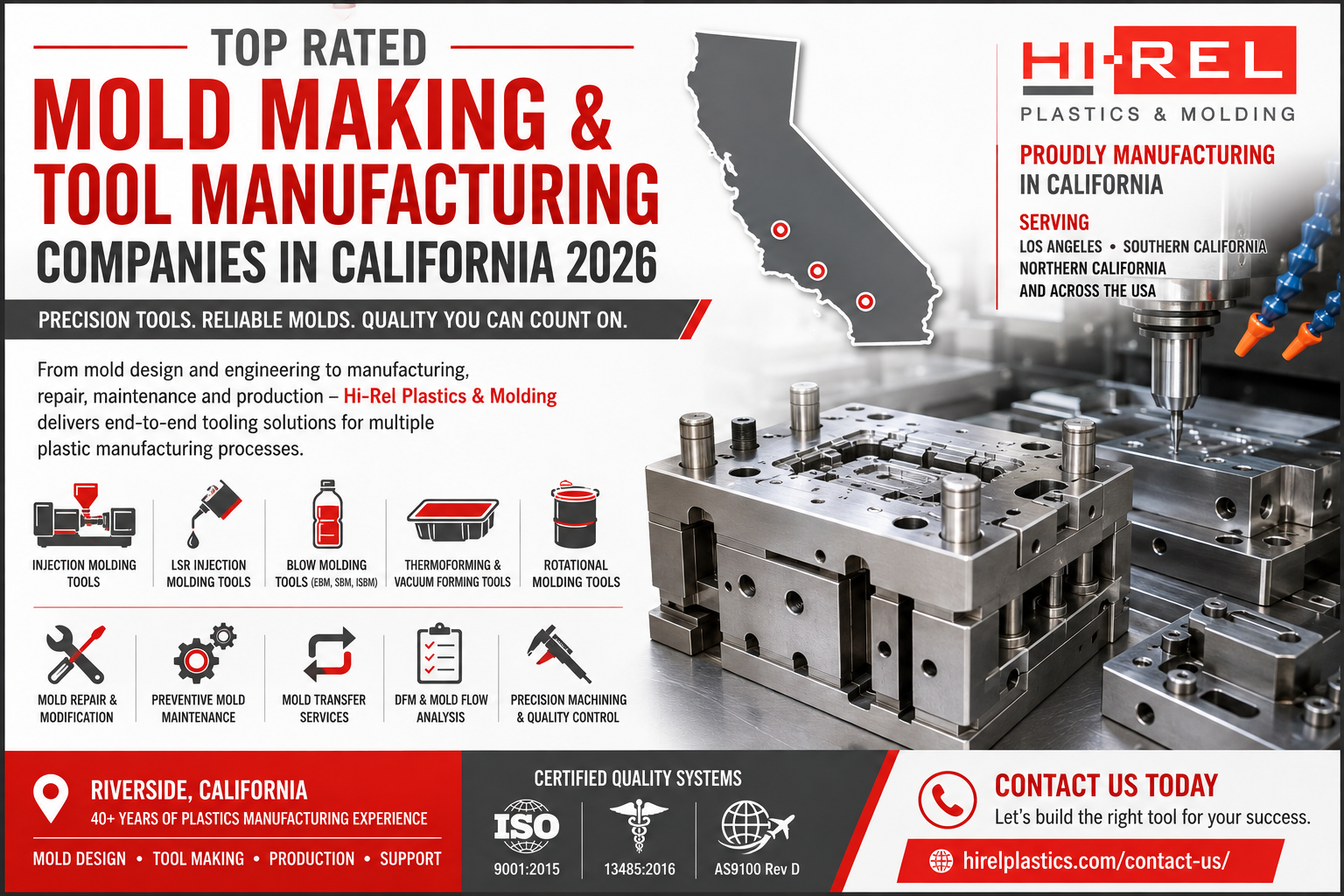
1. Hi-Rel Plastics & Molding Corp. — Riverside, California
Hi-Rel Plastics & Molding Corp. is a Southern California plastics manufacturer providing custom mold making and mold/tool manufacturing services, injection molding, tooling engineering, mold transfer, mold repair, mold maintenance, plastics molding, secondary operations, assembly, and turnkey contract manufacturing services.
Established in 1985, Hi-Rel Plastics & Molding brings more than 40 years of plastics manufacturing experience to tooling and production programs.
A major differentiator is the breadth of manufacturing processes supported by its tooling capabilities. We mold making services are not limited to conventional thermoplastic injection molding.
Hi-Rel Plastics & Molding Mold & Tool Manufacturing Capabilities
Hi-Rel Plastics & Molding provides mold and tooling solutions for:
- Plastic injection molding
- Liquid Silicone Rubber (LSR) injection molding
- Insert molding
- Overmolding
- Extrusion Blow Molding (EBM)
- Stretch Blow Molding (SBM)
- Injection Stretch Blow Molding (ISBM)
- Thermoforming
- Vacuum forming
- Rotational molding
This makes Hi-Rel Plastics & Molding particularly relevant to OEMs with product families that require multiple plastics manufacturing technologies.
Rather than managing separate suppliers for injection molds, blow molds, thermoforming tooling, and rotational molding tooling, customers may be able to consolidate multiple programs with a broader plastics manufacturing partner.
Custom Injection Mold Manufacturing
Hi-Rel Plastics & Molding supports custom injection mold design and manufacturing for prototype, bridge, low-volume, medium-volume, and high-volume production applications.
Tooling configurations can include:
- Single-cavity molds
- Multi-cavity molds
- Family molds
- Insert molds
- Overmolding tools
- Hot runner molds
- Cold runner molds
- Valve-gated molds
- Tools incorporating slides and lifters
- Interchangeable inserts
- Complex production molds
- Automation-ready tooling
DFM & Mold Flow Analysis
Hi-Rel Plastics & Molding can incorporate Design for Manufacturability and Mold Flow Analysis into the tooling development process.
These engineering tools help evaluate potential concerns before mold manufacturing and can assist with decisions involving part geometry, gate placement, runner systems, resin flow, filling behavior, cooling, shrinkage, weld lines, air traps, and potential warpage.
Mold Transfer Services
Hi-Rel Plastics & Molding can also support customers that already own tooling.
Its mold transfer and tooling transfer services can be valuable for OEMs that need to:
- Move molds from another injection molding supplier
- Reshore an existing production program
- Restart production from an idle mold
- Replace an underperforming molding supplier
- Consolidate multiple molds with one manufacturer
- Repair or modify transferred molds
- Establish backup manufacturing capacity
Incoming molds can be evaluated, sampled, repaired, modified, refurbished, and qualified for production as required.
Mold Repair & Mold Maintenance
Hi-Rel Plastics & Molding provides ongoing mold repair, mold maintenance, mold modification, and tooling support services.
Depending on tooling condition and program requirements, services may include mold inspection, cleaning, preventive maintenance, component replacement, insert repair, cavity/core repair, gate repair, slide and lifter repair, ejection-system work, engineering changes, and refurbishment.
This lifecycle approach allows Hi-Rel Plastics & Molding to support tooling beyond initial mold construction.
Quality Certifications
Hi-Rel Plastics & Molding operates quality systems supported by:
- ISO 9001:2015
- ISO 13485:2016
- AS9100 Rev D
This certification combination is particularly valuable for manufacturers serving medical, aerospace, defense, electronics, automotive, and other quality-sensitive industries.
Why Hi-Rel Plastics & Molding Stands Out
Hi-Rel Plastics & Molding’s differentiator is its ability to combine:
Engineering + DFM + Mold Flow Analysis + Mold Manufacturing + Mold Transfer + Mold Repair + Mold Maintenance + Multiple Plastic Molding Technologies + Secondary Operations + Assembly + Contract Manufacturing
under a broader manufacturing relationship.
Best suited for: OEMs seeking a California tooling and plastics manufacturing partner capable of supporting multiple molding technologies, regulated industries, existing mold transfers, and turnkey production programs.
2. Westec Plastics — Livermore, California
Westec Plastics is a long-established Northern California injection molding and mold manufacturing company with more than 50 years of manufacturing experience.
Its tooling capabilities focus heavily on precision injection mold manufacturing and lifecycle tooling support.
The company’s mold building resources include capabilities such as:
- CNC machining
- EDM
- Surface grinding
- Polishing
- Laser engraving
- Mold repair
- Mold refurbishment
- Tool steel selection
- Dimensional verification
Westec supports tooling from prototype injection molds through production tooling and emphasizes the relationship between properly engineered tooling, dimensional consistency, production reliability, and long-term mold performance.
The company’s strong medical and biotech manufacturing presence also makes it relevant for demanding precision molding applications.
Best suited for: medical, biotech, electronics, and precision injection molding programs requiring in-house mold manufacturing and lifecycle tooling support.
3. JG Plastics Group — Costa Mesa, California
JG Plastics Group is an established Southern California plastics manufacturer with extensive experience in precision mold making and custom injection molding.
Its capabilities span engineering, mold making, thermoplastic and thermoset molding, insert molding, overmolding, cleanroom manufacturing, assembly, and secondary operations.
JG’s broad quality certifications and experience serving demanding medical, aerospace, defense, and electronics markets make it particularly relevant to precision tooling programs.
Its integrated model allows customers to work with one organization for tooling development and subsequent production molding.
Best suited for: high-precision injection molds and programs serving medical, aerospace, defense, electronics, and other highly engineered markets.
4. JATCO Incorporated — Modesto, California
JATCO Incorporated is a Northern California injection molding company with dedicated in-house tooling resources.
Its Modesto tooling operation supports mold construction, mold maintenance, and mold modifications.
Tool room capabilities publicly highlighted by JATCO include:
- CNC machining centers
- CNC EDM
- Automated grinding
- Conventional mold making equipment
- Mold construction
- Tool maintenance
- Mold modifications
JATCO also provides broader manufacturing services including plastics engineering, injection molding, assembly, decorating, packaging, warehousing, and distribution.
The company’s integrated manufacturing model can be attractive for customers looking beyond tool building to ongoing production and supply-chain support.
Best suited for: companies seeking mold construction plus high-volume molding, assembly, packaging, warehousing, and distribution capabilities.
5. Fischer Mold — Corona, California
Fischer Mold is a Southern California injection molding and tooling company located in Corona. And fischer Mold is a Southern California injection molding and tooling company located in Corona.
Its in-house tool room provides mold making capabilities backed by extensive combined tooling experience.
The company supports both high-volume and low-volume tooling, as well as soft tooling for rapid prototype development.
Being located in Corona also places Fischer Mold within Southern California’s significant plastics manufacturing corridor serving the Inland Empire, Orange County, Los Angeles, and surrounding markets.
Best suited for: Southern California companies requiring in-house injection mold building, prototype tooling, production tooling, and ongoing molding support.
6. A&S Mold and Die Corporation — Chatsworth, California
A&S Mold and Die provides injection mold tooling, mold manufacturing, mold repair, design, engineering, and plastic injection molding services from its Southern California operation.
Its mold making capabilities include technologies such as:
- CNC machining
- Vertical machining centers
- Sinker EDM
- Precision grinding
- CAD modeling
- Tool inspection
- Mold repair
- Tooling engineering
A&S states precision capabilities down to approximately ±0.001 inch for applicable tooling work and supports industries including automotive, aerospace, medical, electronics, and consumer applications.
The company is also ISO 9001:2015 certified.
Best suited for: precision injection mold manufacturing, mold repair, and plastic injection molding programs in Southern California.
7. KS Group / KS Plastic — San Leandro, California
KS Plastic operates in Northern California and provides precision tooling, plastic injection molding, rapid prototyping, contract manufacturing, secondary operations, and program management.
Its tooling capabilities complement a broader manufacturing operation that supports customers from product development through production.
The company’s Northern California presence makes it particularly relevant to manufacturers in the San Francisco Bay Area, Silicon Valley, Oakland, San Jose, and surrounding technology and manufacturing markets.
Best suited for: Northern California OEMs seeking precision tooling combined with injection molding, prototyping, and contract manufacturing.
8. Trademark Plastics — Riverside, California
Trademark Plastics provides injection molding and mold design and tooling services from Riverside, California.
The company has a particularly strong focus on healthcare and medical-device manufacturing.
Its manufacturing approach incorporates:
prototype development → mold design and tooling → validation → production.
Trademark describes its tooling capabilities around high-precision, long-life injection molds designed according to product specifications and expected production volumes.
The company also supports DFM, medical molding, prototype tooling, production tooling, and validation activities.
Best suited for: medical and healthcare injection molding programs requiring tooling, validation, and production support.
Comparing California Mold Making Companies
When comparing potential California mold manufacturers and tooling companies, purchasing teams should look beyond the quoted mold price.
| Evaluation Area | Why It Matters |
|---|---|
| Mold design | Influences quality, reliability and manufacturing efficiency |
| DFM | Identifies manufacturing concerns before tooling investment |
| Mold Flow Analysis | Helps evaluate resin flow and potential molding issues |
| Prototype tooling | Supports design testing before full production investment |
| Production tooling | Provides durability for sustained manufacturing |
| Multi-cavity tooling | Can increase output and reduce part cost |
| Hot runner expertise | Can reduce runner waste and improve production efficiency |
| Mold sampling | Verifies tool performance before production |
| Mold repair | Extends usable tooling life |
| Mold maintenance | Helps prevent unexpected production downtime |
| Mold transfer | Allows existing tooling to move to a new supplier |
| Production molding | Simplifies transition from tooling to manufacturing |
| Quality certifications | Important for regulated and quality-critical industries |
| Secondary operations | Reduces the need to manage additional suppliers |
| Assembly | Enables more complete contract manufacturing |
Injection Mold Making vs. Tool Manufacturing: What’s the Difference?
The terms mold making, injection mold manufacturing, mold building, tool making, tooling manufacturing, and plastic tooling are frequently used interchangeably within the plastics industry.
However, “tooling” is the broader term.
An injection mold is tooling specifically designed to produce plastic components through injection molding.
Tooling may also describe molds, dies, fixtures, trim tools, inserts, and other production equipment used for processes such as:
- Injection molding
- LSR molding
- Blow molding
- Thermoforming
- Vacuum forming
- Rotational molding
For OEM purchasing managers, the more important question is not what terminology a supplier uses. It is whether that manufacturer understands the specific plastics manufacturing process for which the tool is being designed.
Why Mold Design Matters
The mold is one of the most important investments in an injection molding program.
A poorly engineered mold can potentially create problems such as:
- Flash
- Sink marks
- Short shots
- Weld lines
- Warpage
- Ejection problems
- Excessive cycle times
- Uneven filling
- Cooling problems
- Premature tooling wear
- Excessive maintenance
- Inconsistent dimensions
For this reason, mold development should ideally integrate product design, DFM, Mold Flow Analysis, tool design, material selection, mold manufacturing, molding-process knowledge, and quality requirements.
The lowest initial tooling price does not necessarily produce the lowest total manufacturing cost.
Prototype Molds vs. Production Molds
Tooling requirements should be matched to the expected life of the manufacturing program.
A company needing 500 parts for product testing generally should not approach tooling exactly the same way as an OEM expecting millions of production parts.
Common categories include:
Prototype Tooling
Designed primarily for testing, product development, design validation, and limited quantities.
Bridge Tooling
Provides an intermediate solution between prototype and full production tooling.
Low-Volume Production Molds
Designed for products with modest annual demand where tooling economics are particularly important.
High-Volume Production Molds
Built for extended production life, repeatability, reliability, automation, and potentially millions of molding cycles depending on construction and operating conditions.
California mold makers may use SPI mold classifications from Class 105 through Class 101 to help communicate expected tooling construction and production requirements.
Mold Transfer Services: An Important Capability for OEMs
Companies do not always need a new mold.
Thousands of production molds already exist in manufacturing facilities throughout the United States and overseas.
An OEM may need to transfer a mold because of:
- Supplier performance problems
- Quality concerns
- Delivery problems
- Manufacturing consolidation
- Supplier closure
- Reshoring
- Cost reduction initiatives
- Capacity limitations
- Geographic supply-chain strategy
- Need for secondary operations or assembly
- Need for stronger quality certifications
A capable mold transfer company in California should be able to inspect the incoming tool, determine its condition, identify required repairs, install it in an appropriate molding machine, sample the mold, evaluate molded components, and establish a stable production process.
For OEMs, this capability can sometimes provide a faster path to a new manufacturing relationship than constructing replacement tooling.
Why Mold Repair & Preventive Maintenance Matter
Even a properly designed mold requires maintenance.
Production tooling experiences repeated thermal and mechanical cycling, and mold components can eventually wear.
Potential maintenance areas include:
- Gates
- Ejector pins
- Slides
- Lifters
- Leader pins and bushings
- Inserts
- Cavities
- Cores
- Shutoffs
- Cooling passages
- Hot runner components
- Seals
- Springs
- Wear plates
Regular injection mold preventive maintenance can help identify wear before it develops into a production interruption or quality problem.
This is why buyers evaluating a mold manufacturer should consider the supplier’s ability to support the entire mold lifecycle, rather than only its ability to manufacture a new tool.
Mold Making for LSR Injection Molding
Liquid Silicone Rubber requires tooling knowledge different from conventional thermoplastic injection molding.
LSR injection mold manufacturing may require specialized consideration of:
- Extremely low-viscosity material
- Flash control
- Venting
- Temperature control
- Cold runner systems
- Gate design
- Precision shutoffs
- Automated demolding
- Tight mold tolerances
For medical, electronics, sealing, industrial, and consumer applications, choosing a supplier familiar with both LSR tooling and LSR injection molding can help simplify the transition from tool development to production.
Hi-Rel Plastics & Molding provides both capabilities as part of its broader manufacturing services.
Blow Mold Manufacturing: EBM, SBM & ISBM Tooling
Not every plastic product is injection molded.
Bottles, reservoirs, containers, ducts, packaging, and other hollow plastic components may require blow mold manufacturing.
Hi-Rel Plastics & Molding supports tooling for:
Extrusion Blow Molding — EBM
EBM tooling can be used for bottles, containers, tanks, reservoirs, ducts, handles, and other hollow components.
Stretch Blow Molding — SBM
Stretch blow molding tooling is frequently associated with bottles and packaging requiring controlled material orientation and strength.
Injection Stretch Blow Molding — ISBM
ISBM combines injection molding of a preform with stretching and blow molding to produce finished hollow products.
Companies with multiple packaging or plastic-product requirements may benefit from working with a mold manufacturer capable of supporting more than conventional injection molds.
Thermoforming & Vacuum Forming Tool Manufacturing
Thermoforming uses heat and pressure or vacuum to form plastic sheet over or into tooling.
Typical applications include:
- Medical trays
- Packaging
- Equipment housings
- Transportation components
- Covers
- Industrial products
- Consumer products
Thermoforming mold manufacturing and vacuum forming tooling require different engineering considerations than injection molding, including vacuum flow, heating, material draw, draft, cooling, plug assists, trimming, and dimensional shrinkage.
Hi-Rel Plastics & Molding’s tooling capabilities include both thermoforming and vacuum forming molds, providing customers another option within a multi-process plastics manufacturing program.
Rotational Molding Mold Manufacturing
Rotational molding is commonly used to manufacture larger hollow plastic components.
Products may include:
- Tanks
- Containers
- Housings
- Enclosures
- Industrial products
- Recreational products
- Material-handling products
- Specialty hollow components
Rotomolding tools must account for heat transfer, venting, parting lines, mold release, inserts, and product geometry.
Hi-Rel Plastics & Molding’s ability to provide rotational molding tool manufacturing and rotational molding production further expands its tooling portfolio beyond conventional injection molding.
Why California Is an Important Market for Mold Making & Tool Manufacturing
California’s manufacturing economy includes major concentrations of medical-device, aerospace, defense, electronics, semiconductor, automotive, EV, biotechnology, consumer-product, packaging, and industrial manufacturers.
Southern California contains particularly significant manufacturing clusters around:
Los Angeles • Orange County • Riverside • San Bernardino • Inland Empire • San Diego
Northern California adds important markets around:
San Jose • Silicon Valley • San Francisco Bay Area • Fremont • Oakland • Sacramento
For California OEMs, working with a regional tooling and manufacturing company can provide important advantages, including easier engineering communication, faster troubleshooting, tool access, mold sampling, production support, and supplier visits.
Why Choose a California Mold Making Company?
A California mold manufacturer can offer important benefits for companies developing or producing products in the western United States.
Potential advantages include:
- Easier collaboration between engineering teams
- Faster tooling reviews
- Easier mold sampling
- Reduced travel requirements
- Easier mold-transfer logistics
- Faster engineering changes
- Direct access to tooling
- Local production support
- Improved supply-chain visibility
- Easier quality audits
- Potential reshoring opportunities
- Faster response to mold repairs and production issues
The right choice depends on the program, but geographic proximity can be particularly valuable during tool development, sampling, qualification, engineering changes, and production launch.
Why Choose Hi-Rel Plastics & Molding as a California Mold Making Company?
For companies comparing top mold making companies in California, Hi-Rel Plastics & Molding provides a combination that is not common among traditional standalone tool shops.
Hi-Rel Plastics & Molding supports the customer from:
Product Concept
↓
Engineering & DFM
↓
Mold Flow Analysis
↓
Mold Design & Mold Manufacturing
↓
Mold Sampling & Qualification
↓
↓
Secondary Operations
↓
Assembly & Contract Manufacturing
↓
Mold Maintenance & Repair
That means the company building or managing the tooling also understands how the tool must ultimately perform in production.
More importantly, Hi-Rel Plastics & Molding’s tooling capabilities extend across:
Plastic Injection Molding + LSR Injection Molding + EBM Blow Molding + SBM + ISBM + Thermoforming + Vacuum Forming + Rotational Molding
while its ISO 9001:2015, ISO 13485:2016, and AS9100 Rev D quality systems support demanding OEM markets.
For customers with multiple plastic products or multiple manufacturing technologies, this can reduce supplier fragmentation.
Questions to Ask Before Selecting a Mold Manufacturer
Before issuing a tooling purchase order, OEM buyers should consider asking potential suppliers:
- Do you perform DFM before mold construction?
- Can you perform Mold Flow Analysis?
- What type of molds do you specialize in?
- Do you manufacture prototype and production tooling?
- Can you support multi-cavity molds?
- Do you have hot runner and valve gate experience?
- What tool steels do you commonly use?
- How do you qualify new molds?
- Can you sample the mold in-house?
- Can you manufacture the production parts?
- Do you provide mold repair?
- Do you provide preventive mold maintenance?
- Can you accept transferred molds?
- Can you repair or modify an existing mold?
- What quality certifications do you maintain?
- What industries do you regularly serve?
- Can you provide secondary operations and assembly?
- How are engineering changes handled?
- What tooling documentation is provided?
- How will the mold be supported after production begins?
The answers can help buyers distinguish a basic tool builder from a long-term mold manufacturing and plastics production partner.
Frequently Asked Questions About California Mold Making Companies
What are the top mold making companies in California?
California has numerous established mold makers and tooling manufacturers serving different industries and manufacturing requirements. Companies buyers may evaluate include Hi-Rel Plastics & Molding Corp., Westec Plastics, JG Plastics Group, JATCO, Fischer Mold, A&S Mold and Die, KS Plastic, Trademark Plastics, and other specialized California tooling companies.
There is no single mold maker that is ideal for every program. Buyers should compare tooling expertise, manufacturing processes, certifications, production capabilities, mold maintenance, engineering resources, and industry experience.
How much does a custom injection mold cost?
Injection mold pricing varies significantly according to part size, geometry, number of cavities, mold material, slides, lifters, inserts, hot runner systems, tolerances, surface finishes, expected tool life, and production requirements.
The best way to establish accurate tooling costs is to provide the supplier with a 3D CAD file, drawings, resin requirements, annual quantities, expected program life, and quality requirements.
What is the difference between a mold maker and injection molding company?
A mold maker specializes in designing, manufacturing, modifying, and repairing molds.
An injection molding company operates molding equipment to manufacture plastic components.
Some vertically integrated manufacturers, including Hi-Rel Plastics & Molding, support both mold manufacturing and production injection molding, allowing customers to transition from tooling into production through the same manufacturing organization.
Can an existing injection mold be transferred to another molding company?
Yes. Production molds can frequently be transferred between molding companies.
The receiving manufacturer should inspect and sample the mold to determine its condition and compatibility with available molding equipment. Repairs or modifications may be necessary before production begins.
Can an old injection mold be repaired instead of replaced?
Often, yes.
Depending on the condition of the mold, worn inserts, ejectors, slides, lifters, gates, cavities, cores, cooling components, or other tooling features may be repaired or replaced.
A detailed tool inspection should determine whether repair, refurbishment, modification, or replacement provides the better long-term solution.
What certifications should a mold making company have?
Certification requirements depend on the customer’s industry.
ISO 9001 is widely applicable to quality-management systems, while medical manufacturers frequently seek suppliers operating under ISO 13485. Aerospace and defense customers commonly evaluate suppliers with AS9100 quality systems.
Buyers should always verify the current certification scope directly with prospective suppliers.
Does Hi-Rel Plastics & Molding manufacture only injection molds?
No. Hi-Rel Plastics & Molding supports plastic injection molds, LSR injection molding molds, extrusion blow molding molds, stretch blow molding tooling, injection stretch blow molding tooling, thermoforming molds, vacuum forming tooling, and rotational molding molds.
Does Hi-Rel Plastics & Molding provide mold repair and maintenance?
Yes. Hi-Rel Plastics & Molding supports existing tooling through mold inspection, repair, modification, preventive maintenance, refurbishment, engineering changes, and production support based on the requirements and condition of each tool.
Does Hi-Rel Plastics & Molding accept mold transfers?
Yes. Existing molds can be transferred for evaluation, sampling, repair or modification where necessary, qualification, and ongoing production.
Looking for a Mold Making Company in California?
Choosing a mold manufacturer is an important long-term manufacturing decision.
Whether your company needs a custom injection mold, LSR mold, blow mold, thermoforming mold, vacuum forming tool, rotational molding mold, prototype tool, production mold, mold transfer, mold repair, or preventive mold maintenance, the right tooling partner should understand both how to manufacture the tool and how it will perform throughout production.
Hi-Rel Plastics & Molding Corp. provides mold and tool manufacturing services from Riverside, California, supporting customers throughout Los Angeles, Southern California, Northern California, California, and across the USA.
With more than 40 years of plastics manufacturing experience and ISO 9001:2015, ISO 13485:2016, and AS9100 Rev D quality certifications, Hi-Rel Plastics & Molding can support projects from DFM and mold design through mold manufacturing, production molding, secondary operations, assembly, mold maintenance, and ongoing contract manufacturing.
If you are developing a new product or considering transferring an existing mold, send Hi-Rel Plastics & Molding your 3D CAD files, drawings, material requirements, estimated annual quantities, and project specifications for review.
Ready to Start Your Mold Making Project?
Contact Hi-Rel Plastics & Molding to discuss your custom mold manufacturing, tooling, mold transfer, mold repair, mold maintenance, or plastics production requirements. From Mold Design to Production — One Manufacturing Partner.