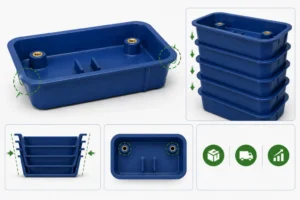
Cleanroom Injection Molding Design and Process is often described in terms of the room, its classification, and its air handling. The part itself, the resin, the mold, and the way parts are removed and packaged matter just as much. A well-classified room cannot compensate for a part design that sheds particles or a process that introduces contaminants through lubricants and handling.
This article looks at cleanroom injection molding from the product side, covering how part design, resin choice, mold care, automation, and testing influence cleanliness. The goal is to help engineers make choices that reduce contamination risk and avoid unnecessary cost before a program reaches production.
Designing Parts for Cleanroom Injection Molding
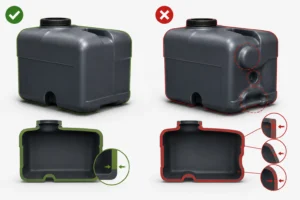
Part geometry affects how easily a component can be kept clean. Sharp internal corners, deep blind pockets, and textured surfaces trap particles and make cleaning less reliable. Smooth surfaces, generous radii, and open geometry are easier to produce, inspect, and clean in controlled molding programs.
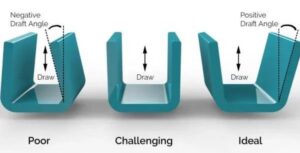
Features that rub against each other, such as snap fits and sliding surfaces, can generate particles in use as well as in manufacturing. Considering this during design, and testing prototypes for particle generation where it matters, prevents problems that are hard to fix once tooling is complete. Wall thickness should stay uniform, and draft angles should be generous so parts release without scraping the mold surface.
Resin Selection for Cleanroom Injection Molding
Resin choice influences cleanliness in several ways. Some materials generate more static, attracting particles, while others contain additives that can migrate to the surface. For Cleanroom Injection Molding Design and Process, resins with stable formulations and minimal processing aids are often preferred, particularly for parts that contact fluids or sensitive products.
Colorants, slip agents, and stabilizers should be reviewed against the application. A material that is acceptable for a general housing may not be suitable for a fluid path component. Reviewing the full formulation with the resin supplier during selection avoids surprises during extractables testing. Resins should also be checked for compatibility with the sterilization method, since irradiation and gas processes can change surface properties.
Lubricants, Mold Release, and Cleaning Agents
Anything introduced into the cleanroom molding process can end up on the part. Mold release sprays, press lubricants, and cleaning solvents all require control. Many cleanroom programs avoid mold release altogether by specifying finishes and draft that allow parts to eject cleanly.
When lubricants are needed, food-grade or cleanroom-compatible products are used, with application procedures that prevent overspray. Cleaning agents are selected for compatibility with both the mold steel and the cleanroom, and their use is documented so that residues are controlled. Operators are trained to apply them only in designated areas and to record each use.
Regrind and Material Handling Policies
Reusing sprues and runners as regrind is common in general molding, but it introduces variability and a possible contamination path. In cleanroom molding for regulated applications, regrind is often prohibited or tightly limited, and any use must be validated and documented.
Material handling also covers drying, storage, and transfer. Resin should move from sealed containers to dryers and hoppers through closed systems where possible, and containers should be opened only in controlled areas. These practices protect both part cleanliness and resin quality, and they make lot traceability simpler when auditors review the records.
Automation in Cleanroom Injection Molding
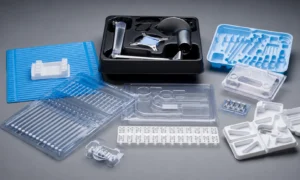
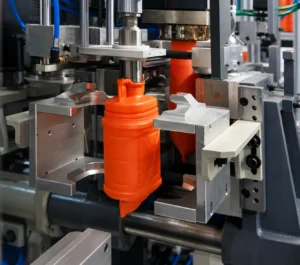
Removing parts by hand introduces the largest source of contamination in many processes, since people shed particles. Robots and automated takeout systems reduce this risk by moving parts directly from the mold to packaging, and they improve consistency of timing and orientation.
Automation in Cleanroom Injection Molding Design and Process must itself be clean. Robot components, grippers, and conveyors are selected to minimize particle generation, and they are cleaned on a schedule. For lower volumes, well-trained operators using strict procedures can achieve acceptable results, but automation becomes more attractive as volumes grow. Automation also reduces the number of times a part is touched, which lowers both contamination risk and handling damage.
Mold Maintenance Inside a Controlled Space
Molds need regular maintenance, and doing it near a cleanroom requires planning. Where possible, maintenance is performed outside the controlled space, and the mold is cleaned before returning. If work must happen inside, procedures define how tools, cleaning agents, and waste are controlled.
Scheduling preventive maintenance around production reduces interruptions to cleanroom molding runs. Documented records of cleaning and repair support quality audits and help show that the process remained in control between production lots. A cleaning log tied to shot counts shows exactly when each mold was last serviced.
Testing Part Cleanliness
Cleanliness can be measured. Particle counts on parts, bioburden testing, and visual inspection under magnification are common methods, chosen according to the application. Results provide direct evidence that Cleanroom Injection Molding Design and Process is producing parts that meet requirements, beyond environmental monitoring of the room itself.
Test frequency and acceptance limits should be defined during validation and tied to risk. Parts for implantable or fluid-contact applications generally receive more rigorous testing than parts that serve as external housings. A clear plan avoids both under-testing and unnecessary cost.
Cost Drivers and Avoiding Unnecessary Cost
Cleanroom molding costs more than standard molding because of facility operation, gowning, monitoring, slower material flow, and added documentation. Costs rise further with higher classifications, so specifying a classification that matches the application is one of the most effective ways to control price. Packaging choices, such as single or double bagging, also change the cost per part.
Other savings come from design. Simplifying geometry, reducing secondary operations, and consolidating parts lower both molding and cleaning effort in controlled production programs. An early conversation with the molder about which requirements are essential can reduce cost without increasing risk.
Why Hi-Rel Plastics Delivers Cleanroom Injection Molding
Hi-Rel Plastics & Molding provides cleanroom injection molding for medical, pharmaceutical, and electronics customers, supported by ISO 13485 and ISO 9001 certification. The company’s engineers review part design, resin, and process choices with customers so that cleanliness is considered from the start.
Hi-Rel can combine molding with secondary operations and packaging under one quality system, which limits handling between steps. That integration helps customers maintain cleanliness and traceability from the press to the shipping box.
Ready to Plan Your Cleanroom Injection Molding Design and Process?
Good cleanroom programs begin with clear requirements for cleanliness, material, volume, and documentation. Sharing those with a molder early allows decisions about design, tooling, and process to be made together.
Hi-Rel Plastics & Molding welcomes inquiries from engineers and procurement professionals evaluating cleanroom molding for an upcoming program. Contact Hi-Rel Plastics & Molding to share your part requirements and discuss how Hi-Rel’s capabilities can support your project.