Extrusion Blow Molding for Large Hollow Parts forms hollow plastic parts by extruding a continuous tube of molten plastic, called a parison, and inflating it inside a mold to take the shape of the finished part. This approach handles larger parts and more complex, asymmetric geometry than injection blow molding, making it the more common blow molding method for products ranging from household bottles to industrial tanks and automotive ducting.
This article covers how extrusion blow molding works, the equipment variations available, and the material and tooling considerations that affect part quality. The goal is to give engineers and procurement professionals a clear understanding of the process before evaluating suppliers for a hollow plastic component.
What Extrusion Blow Molding for Large Hollow Parts Is
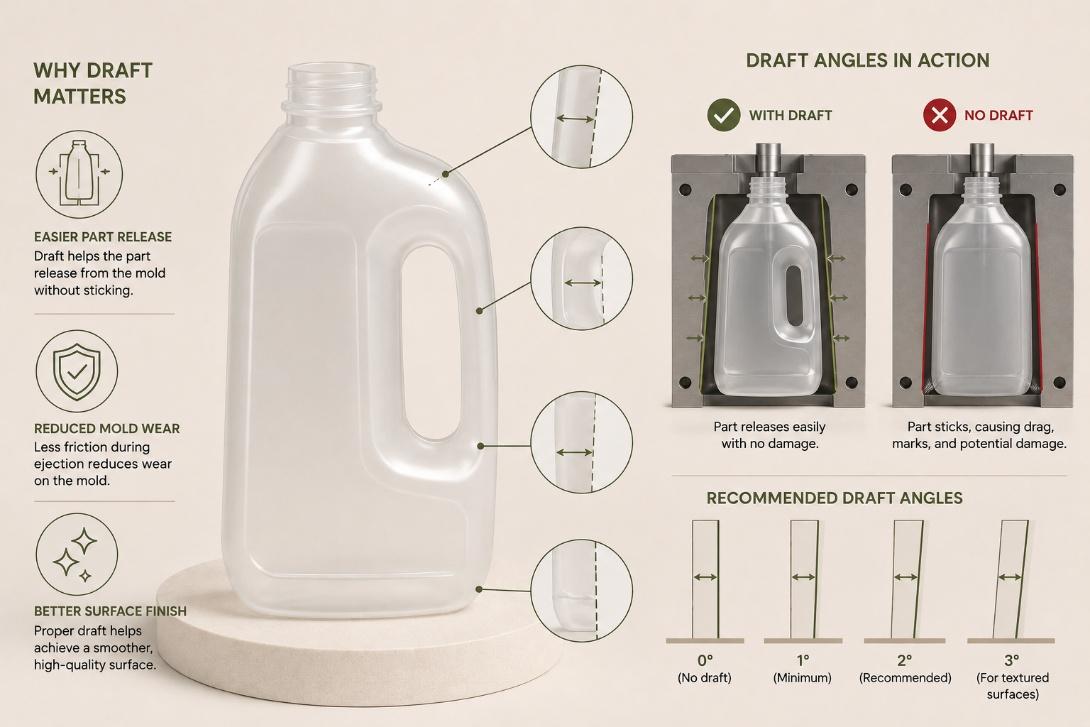
Extrusion blow molding produces hollow parts from molten plastic. The process extrudes a plastic tube between two open mold halves. The mold then closes around the tube. Compressed air inflates the tube until it takes the shape of the mold cavity.
Unlike injection blow molding, the process starts with a continuously extruded tube rather than a discrete preform. This gives manufacturers more flexibility for larger and irregularly shaped parts.
This flexibility makes extrusion blow molding common for bottles with handles, automotive fluid reservoirs, and industrial containers. These parts may be difficult or impractical to produce with a fixed core rod system.
How the Extrusion Blow Molding Process Works
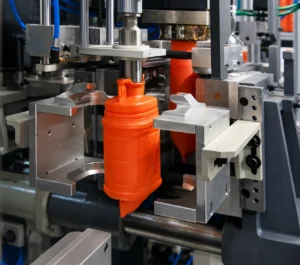
A typical Extrusion Blow Molding for Large Hollow Parts cycle begins with an extruder melting plastic resin and forcing it through a die head to form a hollow tube, or parison, hanging vertically between the open halves of the mold. Once the parison reaches the correct length, the mold closes around it, pinching the top and bottom to seal the tube.
A blow pin then introduces compressed air into the sealed parison, inflating it against the walls of the mold cavity until it takes the final part shape. After a brief cooling period, the mold opens and the part is ejected, with any excess material at the pinch points trimmed away as flash. This cycle repeats continuously in production, with cycle time depending on part size and wall thickness.
Continuous vs. Intermittent Extrusion Systems
Continuous extrusion systems used in the process keep the extruder running constantly, with the mold indexing between multiple parison drop points or shuttling beneath a continuously extruded parison. This approach works well for smaller parts produced at high volume, where consistent extruder output improves overall efficiency.
Intermittent systems, which use an accumulator to store molten plastic and then discharge it in a single rapid shot to form the parison, are better suited to larger parts, since the accumulator can deliver a large parison volume quickly enough to avoid excessive sag or uneven cooling before the mold closes. Choosing between these systems depends heavily on part size and required production rate.
Parison Programming and Wall Thickness Control
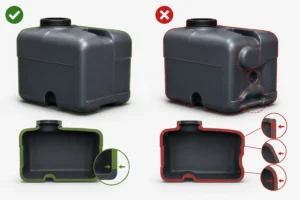
Parison programming is one of the more sophisticated aspects of Extrusion Blow Molding for Large Hollow Parts, involving precise control of the die gap as the parison is extruded to vary its wall thickness along its length. Since the parison stretches unevenly as it inflates into the mold, particularly around corners and geometry changes, programming a thicker starting wall in areas that will stretch more compensates for that variation.
Without effective parison programming, parts can end up with thin spots in high-stretch areas and excess material elsewhere, wasting resin and creating potential weak points in the finished part. Suppliers with mature parison programming capability produce more consistent wall thickness and use less material per part than those relying on a simple, unprogrammed parison.
Materials Used in Extrusion Blow Molding
High-density polyethylene is the most widely used material in extrusion blow molding. It offers a strong balance of impact strength, chemical resistance, and processability across many part sizes. Manufacturers also use polypropylene and PVC. The choice depends on requirements such as temperature resistance, rigidity, and chemical compatibility.
Material selection for Extrusion Blow Molding for Large Hollow Parts must also consider melt strength. Low melt strength can cause the parison to sag during extrusion. Excessive sag can make wall thickness and part dimensions harder to control. This becomes more important with larger parts because the parison may hang longer before the mold closes.
Multi-Layer and Co-Extrusion Capabilities
Some extrusion blow molding programs use co-extrusion, combining multiple resin layers into a single parison to achieve properties no single material could provide alone, such as a barrier layer for chemical resistance combined with a structural outer layer for impact strength. This approach is common in fuel tanks, chemical containers, and other applications requiring specific barrier performance.
Co-extrusion adds complexity to the process, requiring multiple extruders feeding a single die head with precise control over each layer’s thickness and consistency. Suppliers offering this capability should be able to demonstrate experience with the specific material combinations a program requires.
Tooling Considerations for Extrusion Blow Molding
Molds for Extrusion Blow Molding for Large Hollow Parts must be designed with pinch-off areas that seal the parison cleanly at the top and bottom while allowing efficient venting for air trapped between the parison and cavity wall during inflation. Poor venting can leave cosmetic defects or incomplete surface detail on the finished part.
Aluminum tooling supports lower-volume and prototype programs with faster fabrication and lower cost, while hardened steel tooling provides the wear resistance needed for high-volume production. The choice between these tooling materials should reflect the expected production volume and part complexity.
Applications Across Industries
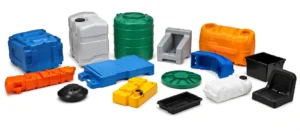
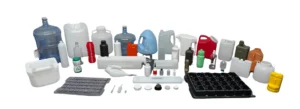
Consumer packaging is a major application for extrusion blow molding. The process produces bottles, jugs, and containers in many sizes and shapes. Industrial manufacturers use it for tanks, drums, and custom containers. These products can require capacities and mounting configurations that stock shapes cannot provide.
Automotive manufacturers use extrusion blow molding for ducting, fluid reservoirs, and other hollow components. These parts must fit specific spaces within a vehicle. Consumer products, agricultural equipment, and outdoor furniture also use the process. It works well when a product requires a large or irregularly shaped hollow part. Plastics Europe also identifies blow moulding among established plastics processing methods.
Why Hi-Rel Plastics Delivers Extrusion Blow Molding Capability
Hi-Rel Plastics & Molding provides Extrusion Blow Molding for Large Hollow Parts alongside its injection molding services, giving customers a single supplier for programs requiring both hollow and solid molded components. The company supports customers through mold design, material selection, and parison programming specific to each extrusion blow molding application.
Hi-Rel’s engineering involvement early in the design process helps customers avoid wall thickness and geometry issues that are expensive to correct after tooling is built. This collaborative approach reflects the same quality discipline the company applies across its broader manufacturing capabilities.
Ready to Start Your Extrusion Blow Molding Program?
Extrusion Blow Molding for Large Hollow Parts can produce larger and more complex parts than some other blow molding methods. Consistent quality requires careful parison programming, tooling design, and material selection. Engage an experienced extrusion blow molding supplier early. Early collaboration can reduce production risks and speed up the path to a validated part.
Hi-Rel Plastics & Molding welcomes inquiries from engineers and procurement professionals evaluating extrusion blow molding for an upcoming program. Contact Hi-Rel Plastics & Molding to share your part requirements and discuss how Hi-Rel’s capabilities can support your project.