Controlled Environment Plastic Manufacturing Cleanroom Guide describes injection molding performed inside environmentally controlled facilities that limit airborne particulate and microbial contamination to levels required by medical, pharmaceutical, aerospace, and electronics applications. Southern California’s concentration of regulated-industry manufacturers — from medical device OEMs in the Inland Empire to aerospace suppliers across the greater Los Angeles basin — creates consistent regional demand for cleanroom plastic manufacturing capabilities. Companies sourcing these services locally benefit from supply chain proximity, easier supplier auditing, and reduced lead times compared to sourcing from distant national suppliers.
The cleanroom molding market in Los Angeles has matured significantly over the past two decades as device complexity and regulatory expectations have increased. Suppliers serving this market today must maintain certified cleanroom environments, ISO 13485 quality systems, validated production processes, and the documentation infrastructure to support customer audits and regulatory submissions. For procurement and engineering teams evaluating cleanroom molding suppliers in the Los Angeles region, understanding what differentiates a genuinely capable provider from one that merely claims the capability is the starting point for effective supplier selection.
Standard injection molding facilities are optimized for throughput, cost efficiency, and dimensional quality — but they make no meaningful effort to control the airborne environment in which parts are produced. In a standard molding facility, particulate contamination from dust, metal wear particles, operator clothing, and ambient air is present at levels that are inconsequential for most industrial applications but unacceptable for medical device components, pharmaceutical packaging, or precision optical parts. Controlled environment plastic manufacturing facilities address this by enclosing the entire production operation — presses, material handling, and personnel — within a controlled environment.
The investment required to build and maintain a cleanroom molding environment is substantial. HEPA filtration systems, positive-pressure air handling, specialized flooring, wall systems, lighting, and gowning infrastructure all represent capital expenditure that standard molders do not carry. Ongoing costs include filter maintenance, environmental monitoring, personnel gowning supplies, and the quality management infrastructure required to demonstrate that the cleanroom maintains its rated classification. These costs are reflected in the pricing of cleanroom molded components, and customers who understand what they are paying for are better positioned to evaluate supplier proposals on their merits rather than on price alone.
ISO 14644-1 is the international standard governing cleanroom classification. It defines allowable concentrations of airborne particles at specific sizes for each class level, ranging from ISO Class 1 — the most stringent — to ISO Class 9, which approximates a typical indoor environment. For controlled environment plastic manufacturing applications in the medical device and pharmaceutical sectors, ISO Class 7 and ISO Class 8 are the classifications most commonly specified. ISO Class 7 permits no more than 352,000 particles per cubic meter at 0.5 microns; ISO Class 8 allows up to 3.52 million at the same threshold.
Selecting the appropriate cleanroom classification for a given component requires understanding the device’s intended use, the nature and duration of patient contact, and the regulatory framework governing the device category. Specifying a more stringent classification than the application requires adds cost without functional benefit. Specifying a less stringent environment than the application demands creates regulatory risk and potential product safety issues. Cleanroom molding suppliers in Los Angeles with experience in regulated industries can help customers determine the appropriate classification based on device type, applicable standards, and downstream sterilization processes.
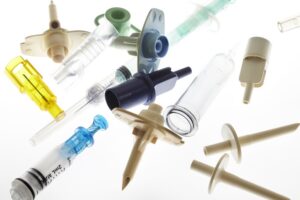
The medical device industry is the primary driver of cleanroom molding demand in the Los Angeles and Inland Empire region. Southern California hosts a significant cluster of medical device companies developing and manufacturing diagnostic equipment, orthopedic and spinal implants, cardiovascular devices, drug delivery systems, and surgical instruments. Many of these companies source injection-molded plastic components that require cleanroom production to meet FDA and ISO regulatory requirements. The proximity of a capable cleanroom molding supplier in Los Angeles reduces supply chain risk and supports the collaborative development relationships that medical device programs depend on.
Pharmaceutical packaging, aerospace, and semiconductor manufacturing also generate cleanroom molding demand in the region. Pharmaceutical packaging suppliers producing primary containers — bottles, closures, and vials for sterile drug products — require cleanroom production to meet GMP requirements. Aerospace companies in the Los Angeles area produce optical components, fluid system parts, and electronic enclosures that must be free of particulate contamination. Semiconductor equipment manufacturers need cleanroom-molded components that will not introduce particles into wafer processing environments. The convergence of these industries in Southern California makes cleanroom molding capacity in the Los Angeles market both strategically important and consistently in demand.
Achieving initial cleanroom classification is only the beginning. Maintaining that classification through ongoing production requires systematic environmental monitoring — continuous or periodic measurement of particle counts, temperature, humidity, and pressure differentials. Particle counting instruments positioned throughout the cleanroom provide real-time data on environmental conditions. Periodic certification testing, typically performed by an independent third-party testing firm, verifies that the cleanroom continues to meet its rated ISO classification under occupied conditions.
Microbial monitoring is an additional requirement in controlled environment plastic manufacturing facilities serving medical device and pharmaceutical customers. Surface sampling and settle plate testing measure microbial contamination levels on work surfaces and in the air column. Results are compared against alert and action limits defined in the facility’s environmental monitoring program. When results approach or exceed alert limits, investigation and corrective action procedures are triggered to identify and eliminate contamination sources before they compromise product quality. This ongoing monitoring infrastructure is a core element of the quality system that regulated customers evaluate during supplier audits.
People are the largest source of particulate contamination in cleanroom environments, shedding skin cells, hair particles, and clothing fibers continuously. Controlled environment plastic manufacturing facilities manage this contamination source through documented gowning procedures, training programs, and behavioral protocols that all personnel entering the cleanroom must follow. Gowning for ISO Class 7 environments typically includes coveralls or frocks, gloves, face masks, hair covers, and dedicated footwear or shoe covers. Entry and exit procedures are defined to prevent contamination of gowning items and transfer of particles into the clean zone.
Personnel qualification for cleanroom work involves initial training on gowning procedures and cleanroom behavior, followed by gowning qualification testing that verifies the individual can gown correctly under observation. Ongoing training and periodic re-qualification ensure that standards are maintained over time and that new employees are properly trained before entering production areas. Suppliers who treat personnel protocols as a core quality discipline — rather than an administrative formality — demonstrate the operational culture that regulated customers need in a cleanroom molding partner.
Materials entering the cleanroom must be introduced through a controlled process that prevents external contamination from being carried into the controlled environment. Resin bags and containers are typically wiped down or passed through an airlock or pass-through chamber before entering the cleanroom. Packaging and shipping materials that generate particulates — cardboard, foam, and kraft paper — are generally not permitted inside the cleanroom. Materials are transferred to cleanroom-compatible containers at the entry point and then introduced into the production area.
Material traceability in controlled environment plastic manufacturing programs must capture which resin lot was used in each production run, along with the certification documentation associated with that lot. For medical and pharmaceutical applications, resin certifications must include material identity, lot number, and relevant compliance data such as USP Class VI or ISO 10993 documentation. This traceability begins at material receipt and must be maintained through production, inspection, packaging, and shipment so that a complete material history is available for each lot of finished components.
ISO 13485 is the quality management system standard that most medical device customers require of their cleanroom molding suppliers. Certification to ISO 13485 requires an independent third-party audit of the supplier’s quality system against the standard’s requirements, followed by ongoing surveillance audits to maintain certification. The standard covers document and record control, management responsibility, resource management, product realization, measurement and analysis, and improvement — all within the context of medical device manufacturing requirements.
In practice, ISO 13485 certification means that the cleanroom molding supplier has documented procedures for every critical process, maintains records that demonstrate those procedures are followed, and operates a systematic corrective action process when deviations occur. Customers auditing cleanroom molding suppliers in Los Angeles under ISO 13485 expectations will review procedure documentation, training records, internal audit reports, corrective action histories, and management review records. Suppliers with robust quality systems welcome these audits as opportunities to demonstrate their capabilities rather than viewing them as compliance burdens.
Process validation is required for cleanroom injection molding serving regulated industries. The validation process establishes documented evidence that the molding operation consistently produces conforming parts within the cleanroom environment. Validation for cleanroom molding encompasses both the environmental qualification of the cleanroom itself and the process qualification of the injection molding operation within it. Environmental qualification verifies that the cleanroom meets and maintains its ISO classification requirements under production conditions. Process qualification verifies that the molding parameters produce conforming parts consistently.
The combination of environmental and process validation creates a comprehensive documented record that the production system — facility, equipment, and process — is in a controlled state capable of producing quality components reliably. This documentation is particularly important for medical device customers preparing regulatory submissions, since it provides objective evidence of manufacturing control that regulatory reviewers expect to see. Suppliers who approach validation as a systematic quality tool — rather than a one-time compliance exercise — produce more reliable long-term production results and reduce the risk of post-launch quality events.
Hi-Rel Plastics & Molding operates in Southern California’s Inland Empire and provides cleanroom injection molding services to medical device, aerospace, and regulated industrial customers throughout the Los Angeles region. The company’s controlled environment production capabilities are supported by quality systems aligned with ISO 13485 requirements and by a team with hands-on experience in the validation, environmental monitoring, and documentation practices that regulated-industry customers require. Hi-Rel’s regional location supports efficient logistics and on-site supplier audits for customers throughout the greater Los Angeles area.
Hi-Rel’s cleanroom molding capabilities are integrated with secondary services including assembly, packaging, and finishing — allowing customers to receive more complete component solutions from a single qualified supplier. The company engages with customers during the design and development phase to provide practical input on part geometry, material selection, and cleanroom process requirements before tooling is committed and production begins. This early-stage collaboration reduces the risk of design changes after validation and supports more efficient program timelines.
Qualifying a cleanroom molding supplier is a meaningful investment of time and resources, and the payoff is a reliable, documented manufacturing relationship that supports product quality and regulatory compliance over the long term. The supplier qualification process for Controlled Environment Plastic Manufacturing Cleanroom Guide typically includes documentation review, facility audit, and a review of existing customer references and quality performance history. Starting this process early — before program timelines become constrained — gives your team the time to conduct a thorough evaluation and complete formal qualification without schedule pressure.
Hi-Rel Plastics & Molding welcomes procurement professionals, quality engineers, and product development teams to contact the Hi-Rel team and initiate a conversation about cleanroom molding requirements. The Hi-Rel team is available to share facility documentation, answer technical questions, and discuss the path from supplier qualification through validated production.