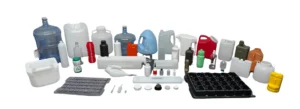

Extrusion blow molding is the most widely used process for producing hollow plastic parts across industrial, automotive, agricultural, and consumer markets. The process uses a plasticating extruder to produce a continuous tube of molten thermoplastic — the parison — which is captured by a split mold, inflated with pressurized air, cooled against the mold walls, and ejected as a finished hollow part. Extrusion blow molding’s combination of design flexibility, material compatibility, process efficiency, and tooling cost advantage over injection-based alternatives makes it the default process for a broad range of hollow part applications — from small consumer containers to large industrial tanks and complex automotive fluid system components.
A thorough understanding of extrusion blow molding helps engineers and procurement professionals work effectively with suppliers. It also supports better tooling decisions and manufacturable part designs. This article covers parison formation, process variants, coextrusion, tooling, and quality requirements for regulated and performance-critical applications.
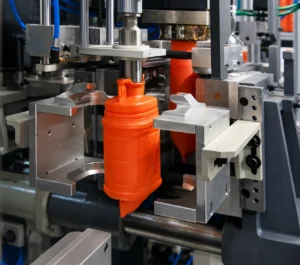
In extrusion blow molding, a plasticating extruder melts thermoplastic resin. It pushes the melt through a die to form a hollow tube, or parison, that hangs from the die head. When the parison reaches its target length and weight, the split mold closes around it. The mold traps and seals the bottom under pinch force. A blow pin supplies pressurized air from the top or, in some configurations, the bottom. The air expands the parison against the mold cavity walls. The plastic cools on temperature-controlled mold surfaces, then the mold ejects the rigid part. Deflashing equipment or hand trimming removes excess plastic at the pinch-off and blow-pin areas.
Parison programming lets the extruder vary parison wall thickness as it runs. Different mold areas stretch the parison by different amounts. Areas farther from the die stretch more and create thinner walls. Therefore, programming adds material where inflation will stretch the parison most. This approach creates more uniform finished-part wall thickness. It is especially important for parts with handles, offset sections, or large surface-area transitions. Without this control, wall variation can affect structural integrity or appearance.
Extrusion blow molding equipment uses either continuous extrusion or accumulator-head extrusion. Continuous extrusion uses a single-screw extruder that runs at a constant rate. Molds cycle quickly to capture successive lengths of parison. This method suits high-volume, small- to medium-size parts, including consumer bottles, automotive fluid reservoirs, and industrial containers. Cycle times can reach a few seconds when the extruder rate matches mold cycling. In addition, multi-cavity shuttle or wheel configurations improve machine utilization by cycling multiple molds against the continuous parison stream.
Accumulator-head extrusion blow molding serves large parts that need more material per shot than a continuous extruder can quickly supply. The accumulator head stores molten material in a reservoir. It then releases the charge rapidly through the die. This capability forms large parisons within the temperature window needed for inflation. Manufacturers commonly use these machines for automotive fuel tanks, agricultural tanks, industrial containers, and other large hollow parts. During machine selection and tooling design, engineers match shot weight, die diameter, and accumulator volume to part requirements.
Coextrusion combines two or more resin layers in one parison. As a result, extrusion blow molding can create wall properties that a single resin cannot provide. Coextruded walls often use HDPE structural layers on the inside and outside. One or more functional layers sit between them. EVOH, or ethylene vinyl alcohol copolymer, is the most important functional layer because it provides gas and liquid barrier performance that HDPE alone cannot deliver. EVOH coextrusion is standard for automotive fuel tanks. It helps manufacturers meet hydrocarbon permeation requirements that single-layer HDPE cannot meet.
Coextrusion can also place regrind layers between virgin-resin outer layers. This reduces material cost while protecting part appearance and surface performance. Adhesive tie layers join resins that otherwise would not bond. Similarly, UV-protective outer layers shield structural layers in outdoor applications. Engineers must understand the materials’ rheological compatibility and thermal behavior during co-extrusion and inflation when designing these parison structures.
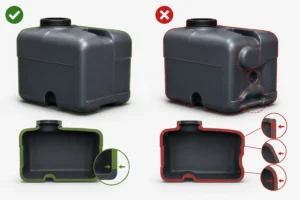
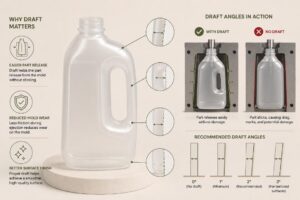
Part design must account for how extrusion blow molding distributes material and forms features. Engineers should analyze wall thickness distribution against parison geometry and mold cavity shape. This analysis confirms that the finished part meets minimum wall thickness requirements at structural locations. High blow ratios create thinner walls because they stretch the parison farther. Designers can use parison programming to add material in these zones. Alternatively, they can modify the design to reduce blow ratio at critical sections.
Integral handles distinguish extrusion blow molded parts from injection blow molded parts, which cannot accommodate them. Handle design requires attention to the parting line at the handle-to-body junction. It also requires review of the handle-section blow ratio and the pinch-off geometry that seals the opening. Container base geometry affects pinch-off weld strength and stability. Flat and recessed bases involve different structural and aesthetic tradeoffs. Therefore, designers should assess stability, stackability, and appearance requirements early. Engaging the extrusion blow molding supplier before tooling is committed helps prevent design-related production issues after molds are built.
The automotive industry is one of the largest and most technically demanding markets for extrusion blow molding. Fuel tanks, windshield washer fluid reservoirs, coolant overflow containers, brake fluid reservoirs, power steering fluid reservoirs, air intake ducts, and various HVAC components are all produced by extrusion blow molding in modern vehicles. These applications impose demanding requirements on material performance — resistance to fuel, coolant, hydraulic fluid, and atmospheric moisture across a service temperature range from well below freezing to elevated underhood temperatures — that require careful material selection and, in the case of fuel tanks, coextruded barrier constructions.
The shift toward electric vehicles is reshaping but not diminishing the role of extrusion blow molding in automotive manufacturing. Battery thermal management systems require coolant reservoirs and fluid circuit components that are well-suited to extrusion blow molding. Air management components for battery cooling and cabin HVAC systems continue to be produced by this process. While traditional fuel system components are declining with the transition away from internal combustion, new EV-specific hollow plastic components are emerging as application areas where extrusion blow molding’s combination of design flexibility, material performance, and production efficiency remains highly competitive.
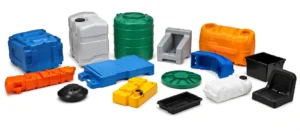
Industrial containers, agricultural tanks, and chemical handling equipment represent a major segment of the extrusion blow molding market. Tanks for fertilizer, pesticide, herbicide, water treatment chemical, and industrial process fluid storage are produced in volumes ranging from a few liters to several hundred liters through extrusion blow molding. HDPE is the dominant material for these applications because of its broad chemical compatibility, UV-stabilizable formulations, and established regulatory compliance for many agricultural and food contact chemicals. The ability to blow-mold tanks with integrated baffles, fittings bosses, and mounting features reduces the number of separately manufactured and assembled components, improving both manufacturing economics and product reliability.
Irrigation system components — including pressure vessels, filter housings, valve bodies, and distribution manifolds — are produced by extrusion blow molding for agricultural water management applications. Construction equipment, material handling vehicles, and industrial machinery incorporate blow-molded fuel tanks, fluid reservoirs, and structural hollow components that benefit from the process’s ability to produce complex shapes with integrated attachment features at competitive per-part cost. The breadth of industrial and agricultural applications for extrusion blow molding reflects the process’s fundamental versatility: wherever a hollow plastic part is needed in a material that can be blow-molded, extrusion blow molding is a practical and often optimal manufacturing solution.
Quality control for extrusion blow molded parts encompasses dimensional inspection, wall thickness measurement, visual inspection, functional testing, and material verification. Critical dimensions — container capacity, neck finish dimensions for closure compatibility, overall part height and width, and features that interface with downstream equipment or assemblies — are measured against engineering drawing requirements. Wall thickness is measured at defined locations using ultrasonic gauges during production and by destructive cross-section analysis during development and first-article qualification. Visual inspection identifies surface defects including incomplete blow, sink marks, contamination, excessive flash, and parting line anomalies that affect appearance or function.
Functional testing for extrusion blow molded containers typically includes leak testing, drop impact testing, and top-load compression testing — tests that verify the container’s structural performance under the filling, handling, and transportation conditions it will encounter in service. For food contact and pharmaceutical applications, extractables testing verifies that the container material does not contribute unacceptable contaminant levels to the product it holds. For automotive fuel system components, permeation testing measures hydrocarbon transmission through the container wall to verify compliance with emissions regulations. The specific test requirements for any extrusion blow molding program should be defined based on the application, regulatory context, and customer specifications before production begins.
Hi-Rel Plastics & Molding offers extrusion blow molding as part of a comprehensive portfolio of plastic manufacturing processes, serving customers in industrial, agricultural, automotive, medical, and consumer markets who require hollow parts produced to their specific design and performance requirements. The company’s experience with process variants, material selection, tooling development, and quality documentation allows its team to engage effectively with customers from the earliest stages of program planning through production and ongoing supply. Hi-Rel’s Southern California location serves the Los Angeles and Inland Empire manufacturing base with efficient logistics and accessible on-site collaboration.
Hi-Rel’s broader manufacturing capabilities — including injection molding, secondary services, and assembly — complement its extrusion blow molding offering and allow customers to source complete product solutions from a single qualified manufacturer. The company’s quality systems support both regulated and non-regulated extrusion blow molding customers, with documentation and traceability practices appropriate for each market’s requirements. Customers looking to develop new extrusion blow molding programs or to qualify a regional alternative supplier for existing production are encouraged to engage Hi-Rel early in the evaluation process.
Extrusion blow molding is the right process for a wide range of hollow plastic part applications — wherever part geometry, material performance, production volume, or tooling cost economics favor it over injection-based blow molding alternatives. Defining the right process for a specific application requires honest evaluation of the part’s dimensional requirements, structural needs, material constraints, and volume, ideally in conversation with a supplier who has direct experience across multiple extrusion blow molding scenarios and can provide process-specific rather than generic guidance.
Hi-Rel Plastics & Molding welcomes inquiries from engineers and procurement professionals with extrusion blow molding requirements at any stage of development or sourcing. Visit hirelplasticsm.com to request a quote or initiate a project discussion with the Hi-Rel team.