Thermoplastic injection molding process engineering principles underpin the most widely practiced plastic manufacturing process in the world, and for good reason. It combines repeatable precision, material versatility, production scalability, and economic efficiency in a way that no other plastic forming process matches across such a broad range of applications. From simple commodity housings to complex multi-feature structural components in medical devices, aerospace systems, and automotive assemblies, this manufacturing approach produces parts that would be impossible or prohibitively expensive to manufacture by any other means. The process is defined by a straightforward concept — melting thermoplastic resin and injecting it under pressure into a precision mold — but the science, engineering, and process discipline required to execute it consistently at high quality are anything but simple.
For engineers designing injection-molded components and procurement professionals sourcing them, understanding thermoplastic injection molding process engineering principles beyond the surface level — what happens inside the mold, how material properties affect part quality, how process parameters interact with part geometry — leads to better part designs, more productive supplier relationships, and fewer surprises in production. Explore Hi-Rel’s thermoplastic injection molding capabilities to see how these principles translate into practice. This article provides a thorough examination of how the process works, what distinguishes thermoplastics from other plastic material classes, how material selection drives part performance, and what quality systems and process controls separate capable suppliers from the rest.
The term thermoplastic refers to a class of polymers that soften and become flowable when heated and solidify when cooled — a process that is physically reversible and can be repeated many times without significant chemical degradation. This reversibility is what makes thermoplastics suitable for injection molding: the material can be melted, injected, and resolidified in the mold, and production scrap or runners can be reground and reprocessed. It also underlies thermoplastics’ recyclability at end of product life, an increasingly important consideration in material selection for many industries.
Thermoplastics are distinguished from thermosets — which cure through an irreversible chemical crosslinking reaction and cannot be remelted — and from elastomers, which are crosslinked rubber materials with distinctive elastic recovery properties. The thermoplastic category itself spans an enormous range of materials from commodity resins like polyethylene and polypropylene to high-performance engineering polymers like PEEK and PEI. Within this range, thermoplastics can be amorphous — with a random molecular structure that gives them transparency, good dimensional stability, and a broad processing window — or semi-crystalline, with ordered molecular regions that provide higher strength, better chemical resistance, and sharper melting transitions but more complex processing behavior. Understanding this structural distinction is fundamental to thermoplastic injection molding process engineering principles and is important for predicting how a resin will process and how the finished part will perform.
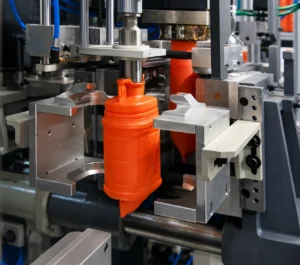
A thermoplastic injection molding process engineering principles cycle begins with the plasticating stage, where solid resin pellets are fed from a hopper into the heated barrel of the injection molding machine. A rotating screw conveys the pellets forward while applying shear heat and barrel heater heat to melt them progressively. The molten resin accumulates in front of the screw tip as the screw retracts — a process called recovery — until sufficient melt volume for one shot has been plasticized. The screw then acts as a plunger, injecting the melt forward through the nozzle, into the sprue, through the runner system, and into the mold cavities under controlled velocity and pressure.
Once the cavity is filled, the process transitions from velocity control to pressure control — the hold or pack stage — where additional material is pushed into the cavity to compensate for the volumetric shrinkage that occurs as the melt cools. The duration and magnitude of hold pressure significantly affect part weight, dimensional stability, and the degree of sink mark formation at thick sections. Cooling then proceeds under the action of the mold’s temperature control system — typically water circulating through channels machined into the mold — until the part has solidified sufficiently to be ejected without distortion. The mold opens, ejector pins or other mechanisms push the part free of the core, and the mold closes to begin the next cycle. Total cycle time ranges from a few seconds for thin-walled small parts to several minutes for thick-walled or large components.
The materials available for this manufacturing process span from low-cost commodity resins to specialty high-performance polymers, each occupying a position in the performance-cost tradeoff that defines which applications they serve. Commodity thermoplastics — polyethylene, polypropylene, polystyrene, and PVC — account for the largest share of global injection molding volume. They are selected for applications where their mechanical properties are sufficient and where material cost is a significant driver of total part economics. Polypropylene, in particular, has expanded its reach from simple packaging into complex technical applications through the development of filled and reinforced grades that significantly extend its mechanical performance.
Engineering thermoplastics — nylon, polycarbonate, acetal, ABS, polyester, and related resins — provide meaningfully higher mechanical performance, heat resistance, and dimensional stability than commodity resins, at higher material cost. They serve applications in automotive, electronics, medical devices, and industrial equipment where commodity resin properties are genuinely insufficient. High-performance thermoplastics — PEEK, PEI, PPS, PPSU, and related specialty polymers — occupy the upper tier of the spectrum, delivering exceptional performance in the most demanding thermal, chemical, and structural environments. The cost premium of high-performance thermoplastics relative to engineering resins is substantial, and their use is reserved for applications where that premium is justified by functional requirements that lower-cost alternatives cannot meet.
The properties of injection molding resins are frequently modified by the addition of fillers and reinforcements that alter mechanical performance, dimensional stability, surface characteristics, or processing behavior. Glass fiber reinforcement is the most widely used modifier, increasing tensile strength, flexural modulus, and creep resistance while reducing shrinkage and improving dimensional stability. Glass-filled grades are available across most thermoplastic families and are specified for structural applications, load-bearing components, and parts requiring tight dimensional tolerances that unfilled resins cannot consistently achieve.
Carbon fiber reinforcement provides the highest specific stiffness and strength enhancement among common reinforcements. However, it costs significantly more than glass fiber. This limits its use to applications where weight and stiffness matter more than material cost. Mineral fillers such as talc, calcium carbonate, mica, and wollastonite improve dimensional stability and reduce warpage. They can also enhance surface quality at a lower cost than fiber reinforcements. Manufacturers widely use them in automotive interiors and other large, appearance-critical parts. Flame retardants, impact modifiers, UV stabilizers, lubricants, antistatic agents, and colorants can further modify base resin properties. These additives help meet specific application requirements. Understanding how these modifications affect processing and finished part properties remains essential. This knowledge supports better material selection within thermoplastic injection molding process engineering principles
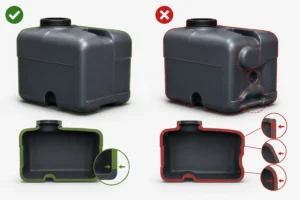
Effective part design requires an understanding of how the process fills, packs, and cools the mold cavity. This forms a core part of thermoplastic injection molding process engineering principles. Uniform wall thickness remains the most fundamental design principle. Uniform walls cool at the same rate and minimize differential shrinkage. This helps prevent warpage and surface depressions called sink marks. When thickness variation becomes necessary, use gradual transitions instead of abrupt changes. Gradual transitions help manage stress concentrations and cooling rate differences. Injection-molded parts typically use nominal wall thicknesses from one to four millimeters. The ideal range depends on part size, material viscosity, and structural requirements.
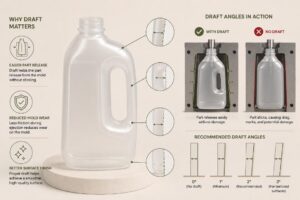
Draft angles create small tapers on surfaces parallel to the mold opening direction. These angles help parts release without dragging or tearing. Smooth surfaces typically need one to two degrees of draft. Textured surfaces need additional draft, usually one degree per 0.025 mm of texture depth. Ribs, bosses, and other functional features also require careful wall thickness design. Keep ribs proportional to the nominal wall thickness. Ribs that are too thick can create sink marks on the opposite surface. The thicker section cools more slowly than the surrounding material. Apply these design-for-manufacture principles early in product development. Engage the injection molding supplier as a design collaborator before finalizing part geometry. Contact Hi-Rel to discuss design-phase collaboration for your program.
The injection mold determines part geometry and influences cycle time, dimensional consistency, and surface quality throughout its production life. Gate design affects how molten plastic fills the cavity. Gate type, size, and location influence the fill pattern, weld line location, and gate vestige appearance. These choices also affect gate removal or automatic shearing. Runner system design determines how the mold handles material between cycles. Cold runners allow material to solidify as scrap. Hot runners keep the material molten between cycles and enable zero-waste injection directly into the cavities.
Cooling system design within the mold is the most consequential tooling element for production efficiency. Cooling time typically accounts for more than half of the total molding cycle. Therefore, reducing cooling time can increase throughput and lower per-part costs. Better channel placement, conformal cooling geometries, and improved mold material management can shorten cooling time. Ejection system design must provide uniform ejection force distributed across the part to prevent distortion or marking during mold opening. Venting uses small channels to let displaced air escape as the melt fills the cavity. Proper venting prevents short shots and burn marks in areas that could trap air. Each tooling element interacts with the thermoplastic material and machine parameters. Together, they determine production quality and efficiency.
Applying thermoplastic injection molding process engineering principles requires understanding how process parameters interact. Melt temperature, mold temperature, injection velocity, pressure, pack pressure, pack time, and cooling time all affect part quality. These parameters also interact with part geometry and material. No parameter operates in isolation. Melt temperature affects viscosity, which influences fill pressure, weld line quality, and surface finish. Mold temperature affects cooling rate, crystallinity in semi-crystalline resins, surface replication quality, and dimensional stability. Injection velocity affects how the melt front progresses through the cavity, influencing orientation, weld line strength, and the tendency for jetting or flow marks at the gate.
“font-weight: 400;”>Process optimization involves establishing a combination of parameters that produces conforming parts consistently within the shortest viable cycle time. Design of experiments — systematically varying process parameters and measuring their effects on critical part characteristics — is the most rigorous approach to process optimization and is standard practice in medical device and aerospace injection molding validation programs. The results of process development define the validated operating window within which the process is maintained in production. Statistical process control monitors critical parameters and part dimensions during production. It provides ongoing evidence that the process remains within its validated state. It also detects process drift early, before teams produce non-conforming parts.
Quality system requirements vary with the industry and application. ISO 9001 provides the baseline quality management framework applicable across industries. ISO 13485 is required for medical device supply chains. AS9100 governs aerospace suppliers. IATF 16949 is the standard for automotive supply chains. Each standard builds on ISO 9001’s foundation and adds industry-specific requirements reflecting the particular risks and regulatory obligations of that market. Suppliers who serve multiple regulated industries may maintain certifications to more than one standard simultaneously.
An effective quality system includes incoming material inspection and lot traceability. It also requires controlled production procedures and in-process monitoring of critical parameters. Teams should inspect finished parts against drawing requirements. They should also manage non-conformances and corrective and preventive actions. Proper tooling management and preventive maintenance also support consistent production.
First article inspection reports document conformance to all drawing dimensions at the start of production. Ongoing statistical process control monitors critical dimensions across production runs. Consistent use of these systems creates reliable production and strong documentation. These results meet the needs of regulated and technically demanding customers. They also support partners applying thermoplastic injection molding process engineering principles.
Hi-Rel Plastics & Molding specializes in precision plastic injection molding. The company supports this work with in-house tooling, secondary operations, and quality systems. Its customers span medical, aerospace, automotive, industrial, and commercial markets. Hi-Rel works with commodity and engineering thermoplastics. Its materials include medical-grade and specialty formulations. The team also supports development builds through high-volume commercial production. Hi-Rel maintains strong quality systems and documented procedures. Calibrated inspection equipment and traceability systems support these processes. These capabilities meet documentation and process control needs across regulated and non-regulated markets.
Hi-Rel engages with customers from the start of each program. The team joins design reviews and provides design-for-manufacture feedback. It also recommends materials and processes based on thermoplastic injection molding process engineering principles. This early collaboration reduces costly design changes after mold construction. It also supports efficient production timelines from development through commercial launch. Hi-Rel’s Southern California location serves a broad regional manufacturing base. Customers benefit from efficient logistics and accessible on-site support throughout the program lifecycle.
Applying thermoplastic injection molding process engineering principles requires the right combination of material selection, tooling design, process control, and quality systems. Choose a supplier with expertise across all these areas, not just press operation. This approach helps maintain quality, cost, and schedule targets throughout production. Engage the supplier before finalizing the design. Early manufacturing input can shape decisions that affect production performance throughout the program’s life.
Hi-Rel Plastics & Molding welcomes inquiries from engineers and procurement professionals at any stage of a precision plastic molding program. Visit hirelplastics.com to submit a project inquiry or request a quote. You can also connect with the Hi-Rel team to discuss your program’s material, tooling, quality, and timeline requirements.