Extrusion Blow Molding Design and Process Control forms hollow plastic parts by extruding a molten tube, closing a mold around it, and inflating it with air. It is the most widely used blow molding method, producing everything from household bottles and industrial drums to automotive ducts and equipment housings. Its flexibility in shape and size comes from the way the tube, called a parison, is formed and controlled.
This article looks at extrusion blow molding through its process mechanics, covering parison formation, pinch-off, wall thickness control, resin choice, machine types, and finishing. The goal is to help engineers and buyers understand what the process does well and which design details matter before a tool is built.
How Extrusion Blow Molding Works
The process begins when an extruder melts resin and pushes it through a die to form a hollow parison. A two-piece mold closes around the parison, pinching it shut at the bottom. Compressed air is blown into the tube, forcing it against the cooled mold walls, and the part cools until it is rigid enough to eject.
After ejection, excess plastic at the neck and pinch-off areas, known as flash, is trimmed away. The cycle then repeats. Because the parison is a free-hanging tube, the process handles a broad range of shapes, including containers with handles and parts with offset necks that other processes cannot form.
Parison Formation and Programming
The die and mandrel set the parison diameter and wall thickness. Because the parison hangs under its own weight and stretches while it is waiting for the mold, thickness changes along its length. Modern machines use parison programming, which adjusts the die gap during extrusion to place more material where the part will stretch most.
Good parison control improves strength, reduces material use, and lowers scrap. Operators set a thickness profile for each tool and refine it during sampling, then lock the settings into the process record. This programmed control is central to consistent quality in Extrusion Blow Molding Design and Process Control, particularly for large or complex parts.
Mold Closing, Pinch-Off, and Flash
Where the mold halves meet, the plastic is pinched together to seal the part. This forms a seam at the bottom, called the pinch-off or weld line, which can be a weak point if the design or process is poorly controlled. Pinch-off geometry affects seam strength, so mold designers shape it carefully. Leak and drop testing on samples confirms that the seam performs as intended.
Flash is created at the neck, the pinch-off, and sometimes around handles. It is trimmed after molding and usually reground and reused, which limits waste. Part designs should allow for flash removal and locate seams where they do not interfere with function or appearance.
Wall Thickness Control in Extrusion Blow Molding
Wall thickness is the most important quality attribute in Extrusion Blow Molding Design and Process Control because it determines strength, stiffness, and material cost. Thin areas can fail under load or leak, while thick areas add weight and lengthen cooling time. Designers aim for uniform thickness where possible and add thickness where loads require it.
Corners, deep recesses, and sharp transitions stretch the material most and tend to thin out. Generous radii, moderate depth, and gradual shape changes help material distribute evenly. Test sections cut from sample parts are used to measure thickness and confirm that the process is under control.
Handleware, Ducts, and Industrial Parts
One distinct advantage of extrusion blow molding is its ability to form integrated handles in a single step. The handle is formed by pinching the parison on both sides of an opening, and the resulting flash is trimmed. This makes the process common for jugs, containers, and carrying cases.
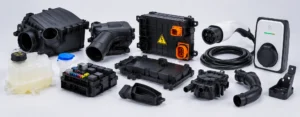
Industrial applications include air ducts, fluid reservoirs, tanks, and enclosures with complex curves. Three-dimensional blow molding techniques move the parison to follow bent tooling, which allows ducts to be formed with bends. These parts replace assemblies of several pieces with one hollow component, which reduces joints, fasteners, and potential leak paths in extrusion blow molding applications.
Resins for Extrusion Blow Molding
High-density polyethylene is the most common resin for extrusion blow molding, valued for toughness, chemical resistance, and cost. Polypropylene provides stiffness and heat resistance, and PVC, PETG, and engineering resins serve specialized needs. The resin must have enough melt strength to hold the parison without sagging.
Multilayer constructions can add barrier layers, recycled content, or colored outer skins. Choice of resin should reflect the contents, the temperature range, regulatory requirements, and mechanical loads, and testing with the actual product helps avoid problems such as stress cracking. For food-contact applications, the FDA regulates substances used in food packaging and other food-contact materials.
Machine Types and Production Rates
Continuous extrusion machines keep the parison moving during production. They suit high-volume bottle manufacturing. The molds move in and out of position as the process runs. This allows continuous production at higher volumes. Intermittent or accumulator-head machines build up a shot of melt and push it out quickly, which suits large parts that would sag if extruded slowly.
Machine selection depends on part size, weight, and volume. Cavity count can range from single to several, and a molder will match the equipment to the program. Sizing the machine correctly avoids paying for capacity that extrusion blow molding runs do not need. Cooling largely determines cycle time. Therefore, mold cooling design directly affects production output.
Regrind, Trimming, and Secondary Operations
Extrusion blow molding can achieve high material efficiency. Operators can regrind trimmed flash and blend it back into production. However, regulated products may limit regrind use. Define regrind limits and traceability requirements before production. Not every application permits regrind. Material controls should therefore match the product’s regulatory requirements.
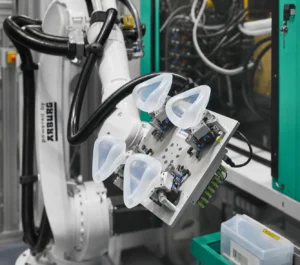
Secondary operations include trimming, drilling, leak testing, labeling, printing, and assembly. Planning these steps with the molding process shortens lead time and reduces handling. Many Extrusion Blow Molding Design and Process Control programs also include inspection of weight, thickness, and dimensions as part of routine quality checks.
Why Hi-Rel Plastics Offers Extrusion Blow Molding
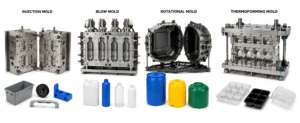
Hi-Rel Plastics & Molding provides extrusion blow molding alongside injection blow, rotational, thermoforming, and injection molding. Its engineers review part geometry with customers and recommend the process and tooling that best match the shape, volume, and performance requirements.
Supported by ISO 13485, ISO 9001, and AS9100D certification, Hi-Rel can support extrusion blow molding programs for medical, aerospace, and industrial customers. Secondary operations and assembly are available under the same quality system.
Ready to Start an Extrusion Blow Molding Design and Process Control Project?
A productive first conversation covers part size, shape, resin, expected volumes, and any regulatory requirements. Sharing a drawing, sample, or sketch early lets the molder identify risks and suggest changes while they are still inexpensive to make.
Hi-Rel Plastics & Molding welcomes inquiries from engineers and procurement professionals evaluating extrusion blow molding for an upcoming program. Contact Hi-Rel Plastics & Molding to share your part requirements and discuss how Hi-Rel’s capabilities can support your project.