Meta Title: Aerospace Injection Molding Material Qualification Guide
Meta Description: Aerospace injection molding material qualification covers high-performance resins, flammability, validation, and traceability. Talk to Hi-Rel.
Slug: aerospace-injection-molding-material-qualification
Aerospace Injection Molding Material Qualification produces lightweight components for aircraft interiors, avionics, ducting, and other systems where weight, flammability, and reliability all matter. Compared with commercial molding, the work involves more demanding materials, stricter documentation, and a longer qualification path. Engineers who understand these differences early can avoid delays and select suppliers with the right capabilities.
This article looks at aerospace plastic injection molding from the materials and qualification side. It covers high-performance resins, flammability and smoke requirements, processing challenges, first article inspection, and traceability, so that design and sourcing teams can set realistic expectations for a program.
What Aerospace Plastic Injection Molding Involves
Aerospace plastic injection molding covers molded parts such as brackets, housings, clips, connectors, ducts, seat components, and interior trim. Some are structural or safety-related, while others are cosmetic, but nearly all must meet defined specifications for material, flammability, and dimensional performance. Customers often add their own specifications on top of industry standards, so the full list of requirements should be gathered before quoting.
Volumes are often lower than automotive or consumer programs, while per-part requirements are higher. A molder serving this market needs disciplined process control, documented procedures, and the flexibility to handle small production runs without compromising quality. Low volumes also make it important that setup and changeover are efficient, since each run carries a larger share of the fixed cost.
Why Aerospace Programs Choose Molded Plastics
Weight is the primary driver. Replacing metal parts with high-performance plastics reduces aircraft weight, which lowers fuel use over a long service life. Molded parts can also combine several features into one component, cutting fasteners, assembly time, and potential failure points.
Plastics also resist corrosion, which reduces maintenance on aircraft systems, offer electrical insulation, and allow complex shapes that would be costly to machine. These advantages explain why aerospace plastic injection molding continues to grow, even though the materials and qualification effort cost more than commodity resins. The savings in weight and assembly often outweigh the higher part cost.
High-Performance Resins for Aerospace Injection Molding Material Qualification
Common aerospace resins include polyetherimide, polyetheretherketone, polyphenylene sulfide, and flame-retardant polycarbonate blends. These materials offer high strength-to-weight ratios, heat resistance, chemical resistance, and inherent flame performance. Selection depends on temperature, load, fluid exposure, and the applicable specification. Material suppliers can provide data sheets, but qualification data for the specific part and process is what the customer ultimately needs.
For aerospace molding, glass or carbon fiber reinforcement raises stiffness and strength but changes shrinkage, warpage, and tool wear. Designers should consult the molder when choosing reinforced grades, because fiber orientation influences strength along different directions and affects gate and rib design.
Flammability, Smoke, and Toxicity Requirements
Cabin materials must meet regulatory flammability standards, and many programs also specify limits on smoke density and toxic gas emission. Aircraft manufacturers often add their own material specifications, so the controlling document for a given part should be identified at the start of a program.
Flame performance in Aerospace Injection Molding Material Qualification can depend on thickness, color, and additives, so test coupons and finished parts may need to be evaluated rather than relying on the resin datasheet alone. Confirming compliance early prevents the expense of changing material after tooling is complete, and it keeps aerospace molding schedules predictable.
Processing High-Temperature Resins
High-performance polymers require higher melt and mold temperatures than common resins, so equipment must be capable of reaching and holding them. Barrel heaters, tool heating, and insulation are selected for these conditions, and tool steels must withstand the temperatures and any abrasive fillers.
Moisture control is critical. Many aerospace resins absorb water and degrade or form defects if molded wet, so drying procedures, hopper systems, and moisture checks are part of a controlled process. Narrow processing windows reward molders with experience and well-documented parameters, and they make process monitoring and operator training especially important.
Tooling and Tolerances in Aerospace Plastic Injection Molding
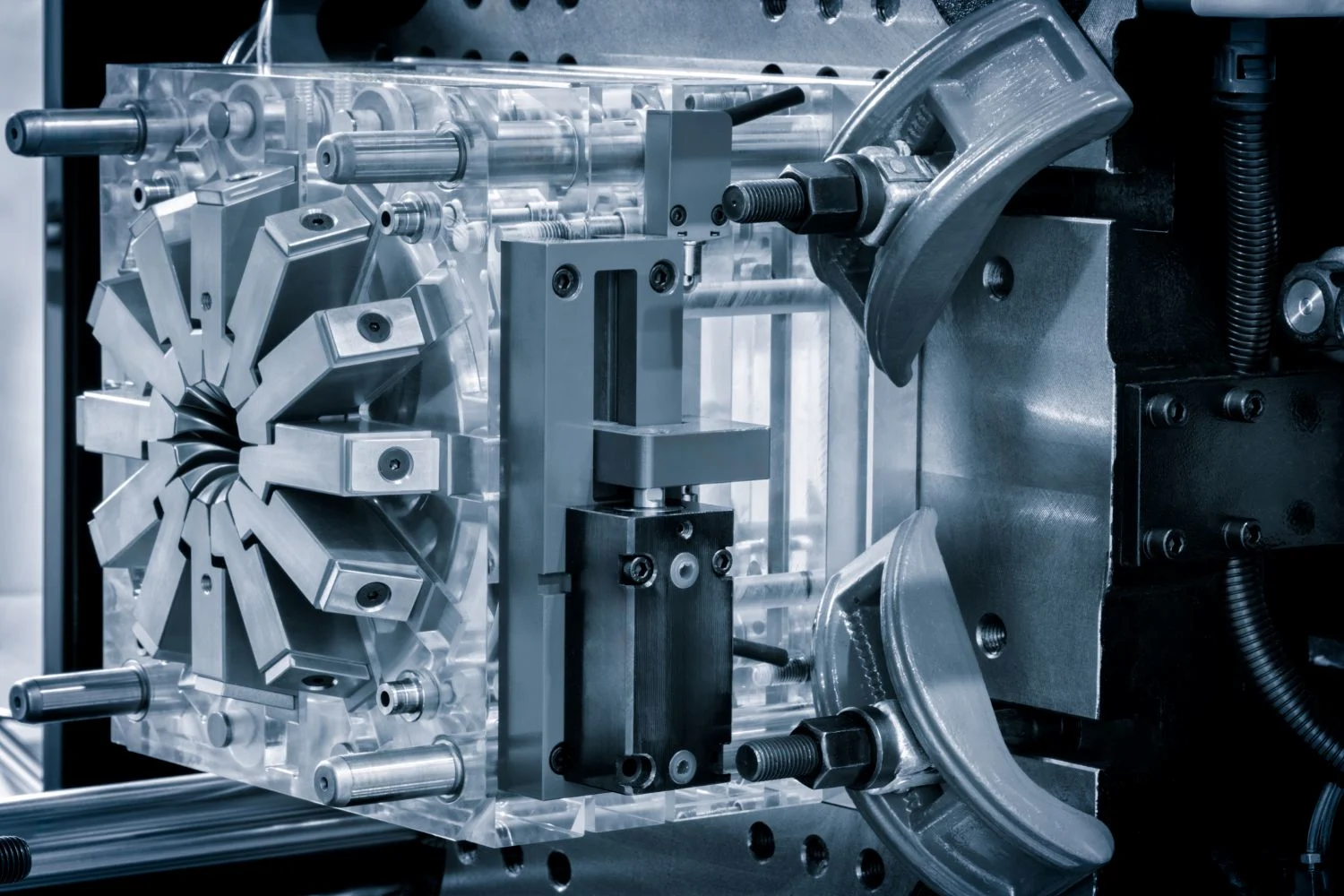
Manufacturers typically build aerospace plastic injection molding tools from hardened steel and carefully design the cooling, venting, and surface finish. Precision matters because these parts often mate with metal structures or other assemblies, and the tool must maintain tight tolerances throughout its service life.
Shrinkage of high-performance resins is predictable but must be accounted for, particularly in reinforced grades where it varies with flow direction. Molders refine tooling during sampling, then confirm dimensions with coordinate measuring equipment and gauges before releasing production. Inspection frequency is set in the control plan and adjusted as capability data accumulates.
First Article Inspection and Process Validation
Aerospace customers usually require a first article inspection that documents every dimension and requirement against the drawing. The report confirms that tooling and process can produce conforming parts and serves as a baseline for future production lots.
In Aerospace Injection Molding Material Qualification, process validation follows, establishing the parameters and limits that will be controlled in production. Capability data, sampling plans, and control plans give the customer evidence that the process is stable. Any later change to tooling, material, or process may require updated validation. The IAQG 9100-series quality framework defines quality management requirements used across aviation, space, and defense supply chains.
Traceability and Configuration Control
Traceability connects every finished part to its resin lot, processing record, and inspection data. In aerospace plastic injection molding, this record supports rapid containment when material or process issues arise. It also helps demonstrate compliance with customer and regulatory requirements.
Configuration control keeps the part, tool, and process consistent with approved documentation. Changes are reviewed and approved before implementation, and records are retained for the required period. Suppliers with mature quality systems manage these controls routinely, which reduces risk for long-running programs and for parts that must be supported for decades.
Why Hi-Rel Plastics Delivers Aerospace Plastic Injection Molding
Hi-Rel Plastics & Molding provides aerospace plastic injection molding supported by AS9100D and ISO 9001 certification. Its engineers work with customers on material selection and design for manufacturability. They also support process development. This helps ensure parts meet specifications from first article through production.
Tooling, molding, secondary operations, and assembly are available under one quality system, which keeps documentation consistent and shortens lead times. Cleanroom manufacturing supports applications that require controlled production conditions. These applications can include sensors, optical assemblies, and electronic components.
Ready to Discuss Aerospace Injection Molding Material Qualification?
A useful first conversation covers the part’s function, controlling specifications, material requirements, volumes, and documentation needs. Sharing drawings and specifications early lets the molder review manufacturability and identify qualification steps before tooling is committed.
Hi-Rel Plastics & Molding welcomes inquiries from engineers and procurement professionals evaluating aerospace molding for an upcoming program. Contact Hi-Rel Plastics & Molding to share your part requirements and discuss how Hi-Rel’s capabilities can support your project.