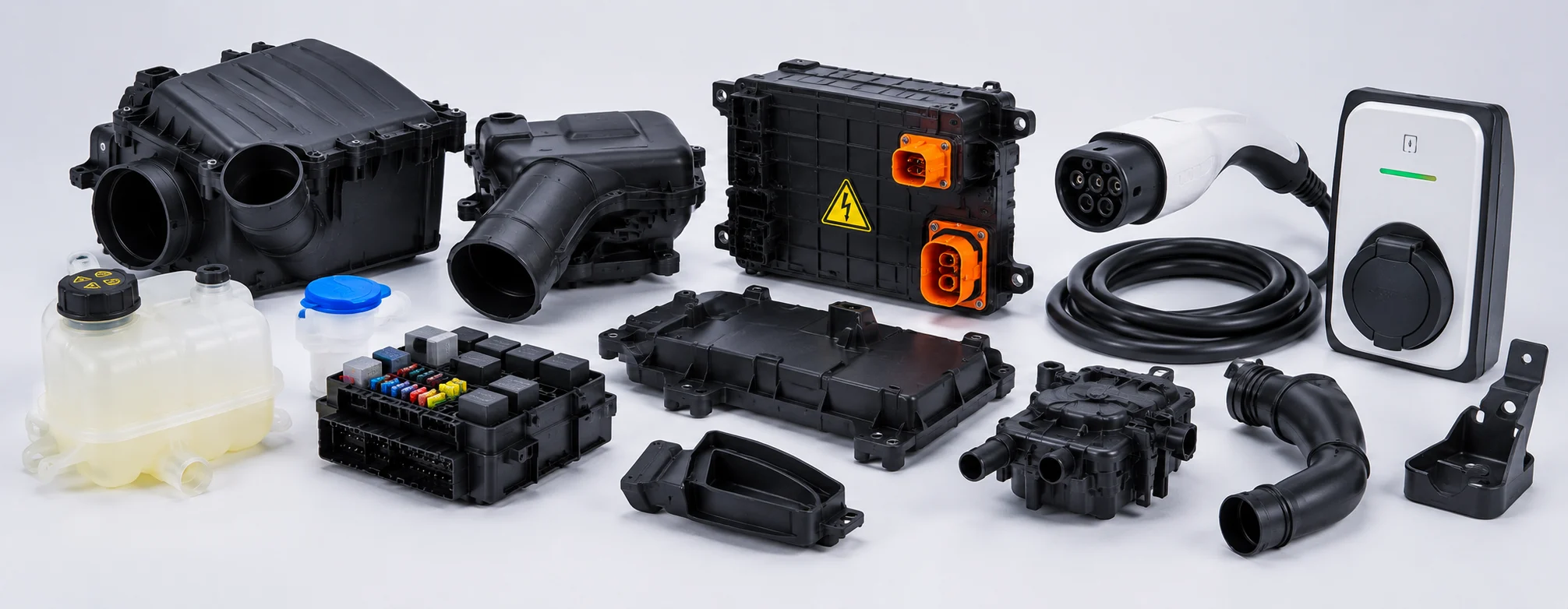
Automotive Plastic Material Selection by Vehicle Zone has become increasingly important as manufacturers pursue lighter vehicles, lower cost, and greater design freedom. A modern vehicle contains hundreds of molded components, from trim clips and connectors to structural brackets and fluid reservoirs. Each part faces different conditions, so the right resin and process choices depend heavily on where the part sits in the vehicle.
This article organizes plastic injection molding for automotive parts by vehicle zone, covering interior, exterior, under-hood, and electric vehicle components, then reviews tolerances, documentation, and supplier expectations. The aim is to help engineers and buyers match requirements to materials and avoid costly mismatches.
Why Automotive Plastic Material Selection by Vehicle Zone Matters
Injection molding can combine several functions into one part, such as mounting points, clips, ribs, and sealing surfaces. Replacing metal assemblies with a single molded component reduces weight, part count, assembly time, and the number of fasteners that must be tracked. These benefits matter in automotive molded parts, where every gram affects fuel economy or battery range.
The process is also repeatable at high volumes, which suits vehicle programs that run for years. Once tooling is validated, molded parts maintain tight consistency from shot to shot. That repeatability supports automated assembly lines, where parts must fit the same way every time, and it is a major reason buyers rely on plastic injection molding for long-running automotive programs.
Interior Components and Surface Quality
Interior parts include door panels, trim, console components, vent housings, and switch bezels. Appearance and feel are critical, so tools carry fine textures or polished surfaces, and defects such as sink marks, flow lines, and gloss variation are closely controlled. Gate placement and wall design are chosen to hide imperfections, and surface texture is specified on the drawing so that the molder can match it consistently from lot to lot.
Interior parts must also resist scratching, tolerate heat from sunlight, and avoid off-gassing that contributes to odor or fogging on glass. Common materials for interior automotive molded parts include polypropylene, ABS, and polycarbonate blends, selected for stiffness, impact resistance, and surface quality.
Exterior Parts and Weathering
Exterior components such as grilles, mirror housings, trim, and lamp parts face sunlight, rain, road salt, temperature swings, and impacts. Resins need UV stabilization and good impact resistance, and painted or coated parts require surface preparation that is compatible with the paint system.
Dimensional stability is especially important in exterior automotive parts because they are visible and must maintain consistent gaps with adjoining panels. Part design, material shrinkage, and cooling all influence warpage, which is why careful process development is part of automotive molding programs for exterior trim. Cooling time, packing pressure, and fixturing after molding all help hold shape.
Under-Hood Parts and Heat Resistance
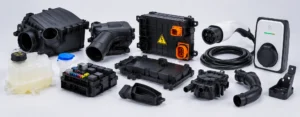
Components near the engine or transmission, such as air intake parts, covers, brackets, and fluid reservoirs, experience high temperatures, vibration, and exposure to oils, coolants, and fuels. Nylons, often glass-filled, and other heat-resistant engineering resins are common choices for these applications.
Under-hood Automotive Plastic Material Selection by Vehicle Zone often involves glass fiber, which improves strength and heat resistance but affects shrinkage, warpage, and surface finish, and it wears tooling faster. Designers account for fiber orientation when locating gates, because strength differs along and across the flow direction. Testing at operating temperature confirms performance, and aging tests show how properties change over a vehicle’s service life.
Electric Vehicle Components
Electric vehicles add parts such as battery housings, connectors, charging port components, and sensor enclosures. These often require flame retardancy, electrical insulation, and dimensional precision, along with light weight to preserve range. Flame-retardant grades of nylon, polycarbonate blends, and polypropylene are widely used.
Thermal management also shapes material choice, since battery and power electronics generate heat that molded parts must tolerate over a long service life. Early collaboration between designers and molders helps balance flame rating, strength, and processing behavior in electric vehicle molded components.
Material Selection for Automotive Plastic Parts
Material selection begins with the operating environment, including temperature range, chemical exposure, load, and expected life. A shortlist of resins is then compared for cost, processing, and appearance. Polypropylene is economical and versatile, ABS offers finish and toughness, nylon gives strength and heat resistance, and polycarbonate blends add impact performance.
Fillers, additives, and colorants change properties, so the final formulation should be validated rather than assumed from a datasheet. In Automotive Plastic Material Selection by Vehicle Zone, changes in resin supplier or grade can require revalidation, so locking down materials early avoids later disruption.
Tolerances, Fit, and Assembly Features
Automotive assemblies depend on parts fitting together without rework. Clips, snap fits, bosses, and locating features must hold dimensions across production lots and temperature ranges. Tolerances should be tight only where function requires it, since tighter specifications add tooling and inspection cost.
Shrinkage and warpage can shift dimensions after molding, so tools are cut with allowances and refined during sampling. Measurement systems verify that parts meet drawing requirements before production release. Coordinate measuring machines and inspection fixtures can support this verification. Ongoing checks then reveal whether the process begins to drift during production.
Documentation and Traceability for Automotive Plastic Parts
Automotive customers typically require formal production part approval, with dimensional reports, material certifications, process documentation, and capability studies. Suppliers of automotive molded parts need disciplined records of process parameters, inspection results, and lot traceability so that issues can be contained quickly if they arise.
Change control is equally important. Any modification to tooling, material, or process should be communicated and approved. A molder with established quality systems makes these requirements easier to meet and reduces risk for programs that run for many years. The IATF 16949 automotive quality framework establishes industry-specific quality management requirements for automotive production and relevant service part organizations.
Why Hi-Rel Plastics Delivers Plastic Injection Molding for Automotive Parts
Hi-Rel Plastics & Molding provides plastic injection molding for automotive, medical, aerospace, and industrial applications. The company supports these programs with ISO 9001 and AS9100D certification. Its engineers review designs for manufacturability, recommend materials, and develop processes that hold tolerances consistently.
Tooling, molding, secondary operations, and assembly are available under one quality system, which reduces handoffs and keeps documentation consistent. For automotive molded parts that need finishing or subassembly, that integration shortens lead time and simplifies supply.
Ready to Discuss Automotive Plastic Material Selection by Vehicle Zone?
A useful first conversation covers part function, location in the vehicle, resin requirements, volumes, and documentation needs. Sharing drawings or models early lets the molder review manufacturability and identify risks while changes are still inexpensive.
Hi-Rel Plastics & Molding welcomes inquiries from engineers and procurement professionals evaluating automotive plastic components for an upcoming program. Contact Hi-Rel Plastics & Molding to share your part requirements and discuss how Hi-Rel’s capabilities can support your project.