Thermoforming design principles process selection begins with understanding what the process makes possible. It also requires knowing where thermoforming outperforms alternatives. The process heats flat thermoplastic sheet until pliable. It then forms the sheet over or into a mold. Vacuum pressure, compressed air, or mechanical force accomplishes this forming. The process spans an extraordinarily wide range of applications. Aircraft interior panels use thermoforming. Medical device packaging relies on it. Automotive trim, food containers, and industrial enclosures all get produced this way. Retail packaging also benefits from this manufacturing approach. What unites these diverse applications is a shared set of manufacturing economics. Thermoforming tooling costs a fraction of injection mold tooling for comparable part sizes. The process is well-suited to large, relatively shallow parts. Parts that would be impractical or expensive to injection-mold fit perfectly here.
For engineers and procurement professionals evaluating manufacturing options, thermoforming design principles process selection deserves serious consideration. This applies when part geometry and volume fall within the process’s strengths. The decision between thermoforming and injection molding depends on several factors. Geometry matters significantly. Material requirements drive choices. Dimensional tolerances influence decisions. Production volume affects economics. The specific functional requirements of the application guide everything. Explore Hi-Rel’s thermoforming capabilities to see how these principles translate into production results. This article examines process variants, materials, tooling, design considerations, quality systems, and key application areas. It focuses on where thermoforming provides the best technical and economic solution.
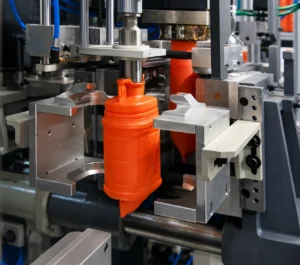
Applying thermoforming design principles process selection well requires understanding which variant fits the application. Vacuum forming is the simplest and most widely used variant. The heated sheet drapes over or into a mold. A vacuum then applies between the sheet and the mold surface. This pulls the plastic into contact with the mold geometry. Vacuum forming produces good results for relatively simple shapes. It works well with modest detail requirements. Its tooling and equipment are less expensive than pressure forming. This makes it cost-effective for large parts and lower-volume programs.
Pressure forming adds compressed air to the top of the sheet. This happens simultaneously with vacuum from below. The total forming pressure increases significantly. The result is sharper detail and tighter corner radii. Surface texture replication improves beyond what vacuum alone achieves. Pressure-formed parts approach the appearance quality of injection-molded components. This makes pressure forming the appropriate choice for customer-visible applications. Surface detail and texture matter most in these cases.
Twin-sheet thermoforming forms two sheets simultaneously. It fuses them together at specific locations. This produces hollow parts with structural integrity. Industrial containers, pallets, and automotive load floors use this process. Other hollow structural components benefit as well. Matched-die thermoforming uses complementary male and female mold halves. It controls both surfaces of the formed part. This provides dimensional accuracy and consistency. Single-sided tooling cannot achieve this for the tightest tolerance requirements.
The comparison between thermoforming and injection molding is the most common process selection decision engineers face. The right answer depends on several factors specific to the part and program. Tooling cost is the primary economic differentiator. Thermoforming molds cost significantly less than injection molds of equivalent part size. Aluminum production tools demonstrate this advantage clearly. They define only one surface of the part. They also do not need to withstand extreme injection molding clamp forces. For large parts such as panels, enclosures, and trays, this cost differential can be dramatic. Surface areas of a square foot or more amplify this advantage. Thermoforming becomes the only economically viable route at volumes typical of many industrial and aerospace programs.
Injection molding offers clear advantages in specific situations. Parts with complex three-dimensional geometry on both surfaces often favor injection molding. Tight tolerances also support this choice. Injection molding also suits internal features such as ribs, bosses, and threaded holes. Wall thickness consistency provides another advantage over thermoforming. Thermoforming produces parts from sheet stock. The finished wall thickness depends on the starting sheet thickness. It also depends on how much the sheet stretches during forming. Areas with greater stretch become thinner, creating unavoidable thickness variation. In contrast, injection molding allows engineers to specify wall thickness directly. Parts with critical wall thickness requirements often favor injection molding. The same applies to parts with multiple functional features in compact geometries. Injection molding carries higher tooling costs. However, its design and performance advantages can justify that investment. Understanding these tradeoffs supports effective thermoforming design principles and process selection. Contact Hi-Rel for guidance on which process best fits your application.
Sound thermoforming design principles process selection depends on matching material properties to application requirements. ABS is one of the most widely thermoformed engineering resins. Its toughness distinguishes it from alternatives. Good forming characteristics make it practical to work with. It achieves fine surface detail in pressure forming. Compatibility with painting and secondary finishing operations adds versatility. ABS is used extensively for equipment housings and medical device enclosures. Automotive interior components rely on it. Industrial covers use it where appearance, impact resistance, and formability combine.
Polycarbonate is thermoformed for applications requiring higher impact resistance. Optical clarity also drives its selection. Aircraft windows and transparencies use polycarbonate. Safety shields, display covers, and illuminated sign faces are common examples. PETG provides glass-like clarity with better impact resistance than standard PET. It is widely used in medical packaging and retail packaging. Food contact applications also use it. FDA compliance and optical properties are both required in these cases.
High-density and low-density polyethylene are thermoformed for industrial trays. Agricultural components and chemical-resistant applications use these materials. High-performance resins including PEI, PEEK, and flame-retardant ABS serve aerospace interior components. Light weight is a requirement there. Specific flammability compliance is mandatory. Adequate mechanical properties must also be met. Material selection for any thermoforming program begins with the application’s functional requirements. The process works backward to identify which materials meet those requirements. Availability in sheet form suitable for the forming process is also a consideration.
Thermoforming tooling is less expensive than injection mold tooling. It is also faster to produce. This cost advantage is one of the most important reasons thermoforming design principles process selection favors this approach. It particularly applies to large parts and lower-volume programs. Prototype thermoforming tooling can be produced from wood, tooling board, or medium-density fiberboard. Production takes days rather than weeks. This allows rapid design iteration during product development. Tooling cost at this stage remains minimal.
Production aluminum tooling is the standard for commercial thermoforming programs. It is machined to provide better surface finish than prototype materials. Dimensional accuracy and thermal performance also improve. It is durable enough for hundreds of thousands of production cycles for most applications.
Thermoforming molds are classified as male or female. Male molds are also called plug or form molds. The classification depends on whether the sheet forms over the outside of the mold or into the inside. Male molds define the inside surface of the formed part. They are used when interior dimensions are critical. Female molds define the outside surface. They are used when exterior appearance or exterior dimensions are the priority. The choice affects wall thickness distribution in the finished part. Female tooling generally produces better detail on the exterior surface. Male tooling provides more controlled interior dimensions.
Vacuum holes are small-diameter channels drilled through the mold surface. They allow trapped air to escape as the heated sheet contacts the mold. This ensures complete and uniform forming contact. Hole diameter and placement pattern matter. The vacuum system’s capacity also plays a role. Together these factors determine how quickly and completely the sheet conforms to the mold surface during forming.
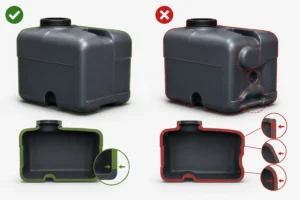
Designing parts for thermoforming requires understanding the process’s capabilities and constraints. These differ meaningfully from injection molding design. This understanding is at the heart of effective thermoforming design principles process selection. Draw ratio is the primary constraint on thermoformed part geometry. It represents the relationship between the depth of a formed feature and its opening dimension. Features with high draw ratios stretch the sheet significantly. This produces thin walls that may be inadequate for structural requirements. Design guidelines typically recommend draw ratios below 1:1 for standard materials and forming conditions. Specific materials, mold temperatures, and forming pressures can extend this range for particular applications.
Corner radii in thermoformed parts should be as generous as the design allows. Sharp interior corners concentrate forming stresses. They produce thin, potentially weak zones at the corner. Generous radii distribute the material more evenly. They produce stronger, more consistent wall thickness as a result.
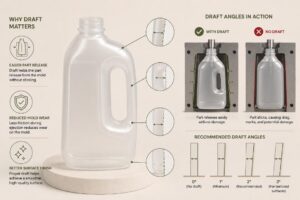
Draft angles are tapers on walls that run parallel to the forming direction. They aid in part release from the mold. This is particularly important for female-tooled parts. The formed part must be pulled out of a cavity in these cases. Undercuts that would trap the part in the mold are generally not feasible. Single-sided thermoforming tooling cannot accommodate them without mechanical assists. Design should avoid undercuts wherever possible. Early engagement with the thermoforming supplier during part design identifies these constraints early. This prevents locking them into tooling. It also captures the supplier’s experience with similar geometries and materials.
Aerospace interior manufacturing is one of the most technically demanding applications of thermoforming design principles process selection. Overhead storage bins, sidewall panels, and ceiling panels get produced here. Galley components and seat backs also use this process. Pressure forming of high-performance thermoplastics accomplishes this. PEI and flame-retardant ABS are particularly common materials. These must meet FAA flammability requirements of FAR 25.853. This standard governs all commercial aircraft interior materials. Large panel size, flammability compliance, and structural performance requirements combine here. Together they make thermoforming the manufacturing process of choice for most cabin interior components. Injection molding tooling costs would be prohibitive at these sizes. Composite fabrication would be more expensive and labor-intensive.
Aerospace thermoforming programs operate under AS9100 quality management systems. First article inspection requirements apply. Material traceability obligations are also mandatory. These differ qualitatively from commercial thermoforming programs. Flammability test compliance must be documented for the specific material lot. The specific thickness and manufacturing process used in production must also be documented. Generic material data alone is not sufficient. Dimensional requirements for aerospace interior components are driven by interface needs. Parts must fit within the aircraft’s interior geometry. They must also interface with adjacent structures, panels, and mechanical systems. Thermoforming suppliers with established experience in aerospace interior programs bring the quality infrastructure these programs require. Regulatory knowledge and process discipline are equally important alongside forming capability.
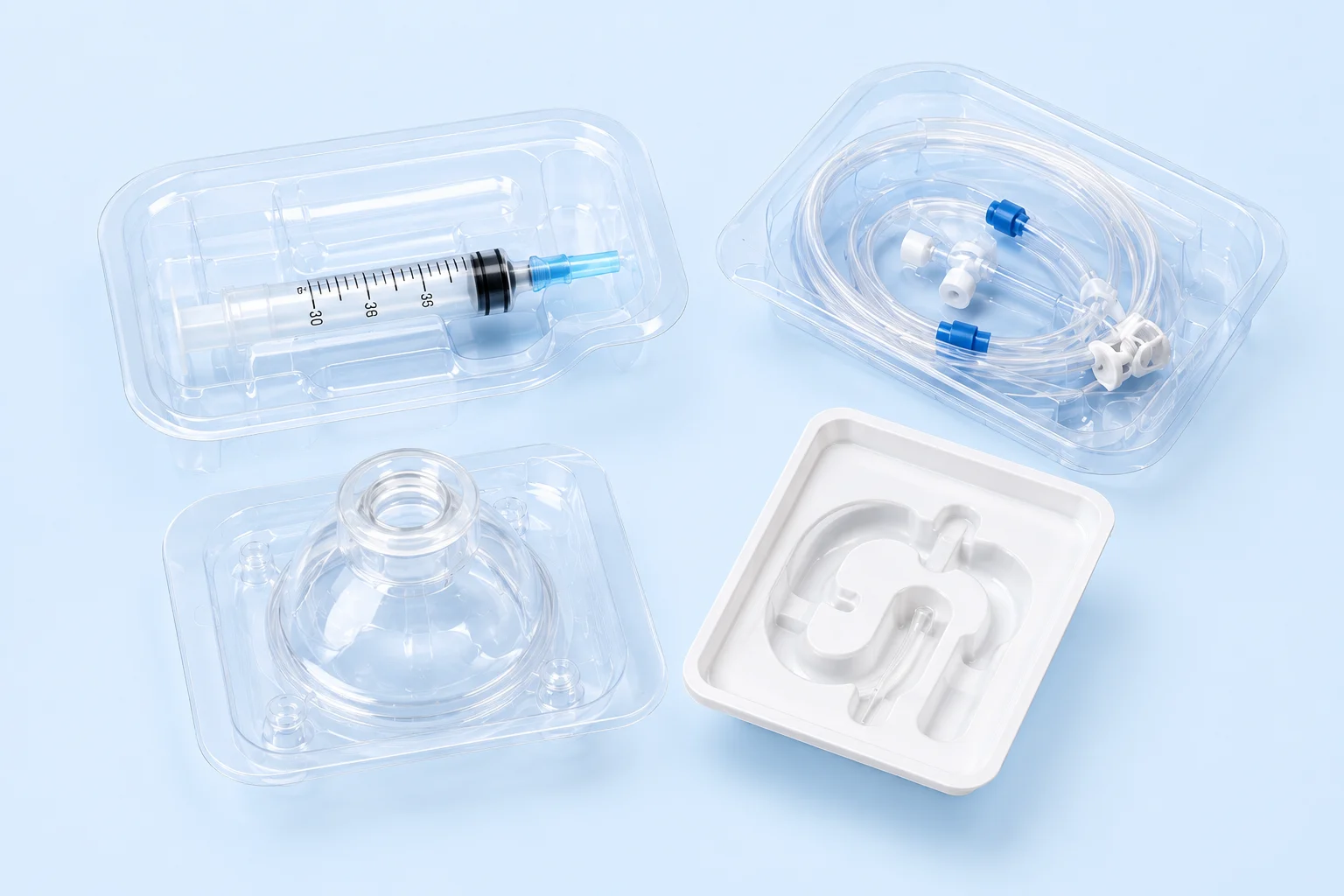
Medical device packaging represents one of the highest-volume applications in the thermoforming design principles process selection landscape. Blister packs, clamshell packages, and trays for single-use sterile devices get produced in very high volumes. Thin-gauge thermoforming on continuous web equipment accomplishes this. The packaging must maintain device sterility through distribution and storage. It must survive sterilization processes including ethylene oxide and gamma irradiation. Tamper evidence is required. FDA regulatory requirements for sterile barrier systems must be met. PETG, PVC, and polypropylene are the most commonly used materials for thermoformed medical device packaging. Selection depends on sterilization compatibility, clarity requirements, and sealing characteristics. Tyvek or foil lidding systems define these sealing needs.
Thermoforming for medical device packaging operates under ISO 11607. This standard governs packaging for terminally sterilized medical devices. ISO 13485 quality management systems also apply. Package validation is required before commercial distribution. This includes seal strength testing and microbial barrier validation. Accelerated aging studies are also mandatory. Suppliers who understand the medical device packaging regulatory framework provide meaningfully more value. They can support the validation documentation that device manufacturers require. This far exceeds what suppliers offering only the forming operation can deliver.
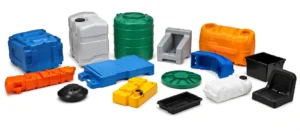
Industrial equipment enclosures, machine covers, and protective panels represent a substantial market segment. Material handling components also belong here. For these applications, thermoforming’s tooling cost advantage makes it more economical than alternatives. Its ability to produce large, contoured shapes with integrated attachment features adds further value. Injection molding and sheet metal fabrication cost more at volumes typical of industrial OEM programs. ABS and high-impact polystyrene are the most commonly thermoformed materials for industrial applications. Polycarbonate is used where impact resistance or transparency requirements demand it.
Food service trays, deli containers, and produce packaging are produced in enormous volumes. Disposable foodservice items also use this process. Thin-gauge thermoforming handles all of these. This represents one of the highest-volume applications of the process globally. These commodity food packaging applications differ greatly from precision industrial and medical thermoforming. Quality system requirements vary considerably. Material complexity also differs. However, they demonstrate the process’s fundamental throughput capability. They also show the breadth of the application landscape that spans thermoforming design principles process selection decisions. For industrial and commercial programs, thermoforming provides a well-established and cost-effective manufacturing solution. Food contact compliance and dimensional consistency can both be achieved.
Hi-Rel Plastics & Molding offers thermoforming alongside injection molding and secondary service capabilities. Customers gain access to both processes from a single qualified manufacturer. The company serves medical, aerospace, industrial, and commercial customers. Their applications align with thermoforming’s strengths: large parts, moderate tolerances, and lower-volume programs. Applications where tooling cost is a primary constraint also benefit. Hi-Rel’s quality systems support thermoforming customers in regulated markets. The same rigor applied to injection molding programs carries over. Material traceability, dimensional inspection, and process documentation are all standard.
Hi-Rel’s ability to provide both thermoforming and injection molding from a single facility is particularly valuable. Some customers have products that include components suited to each process. A thermoformed housing paired with injection-molded internal components is one example. This arrangement consolidates vendor relationships. It also simplifies quality management. Consistent standards apply across the complete plastic component set. The company’s Southern California location provides logistics efficiency for customers throughout the Los Angeles and Inland Empire regions and across the broader Western United States market.
Thermoforming design principles process selection offers compelling economic advantages for large parts and lower-volume programs. Applications where a single formed surface defines the critical geometry and appearance benefit most. The most effective way to evaluate whether thermoforming is the right process is a technical discussion with an experienced supplier. That supplier should have experience in both thermoforming and injection molding. They should honestly assess the tradeoffs rather than defaulting to the process they are most comfortable running. Understanding your application’s dimensional requirements before that conversation makes it more productive. Material needs, volume forecast, and regulatory context matter equally. Better process selection decisions follow from this preparation.
Hi-Rel Plastics & Molding welcomes inquiries from engineers and procurement professionals evaluating thermoforming for new or existing programs. Visit hirelplastics.com to submit a project inquiry or request a quote. Connect with the Hi-Rel team to discuss whether thermoforming, injection molding, or a combination of both is the right manufacturing approach for your application.